Thursday, February 03, 2005
Europe’s Crisis
Arthur Waldron
The great transatlantic European-American divorce, about which we have heard so much: is it really going to take place?
A few months ago, from the other side of the Atlantic, it looked like a done deal. Seldom had the sheer weight of European opinion seemed so monolithically averse not only to American policies but to the American character, especially as represented by President George W. Bush. Before the November election, polls of the British parliament suggested that 87 percent of that body’s members would have voted for John Kerry; among Tories, only 2 percent stated that they would be “delighted” by Bush’s reelection. After the event took place, Le Soir of Brussels spoke for many in characterizing the reaction of European elites as “no longer about policy, but a matter of rage”—rage, the paper elsewhere went on to explain, over America’s “anaesthetization by a detestable mixture of economic-financial interest groups, blind militarism, religious fundamentalism, and neoconservative propaganda.”
To be sure, this latest outburst of European America-loathing has roots, even deep roots. Readers of a certain age will remember the demonstrations in Britain of the Campaign for Nuclear Disarmament, founded in 1957; the massive Europe-wide protests against the Vietnam war in the 1970’s; or the hysteria over European deployment of Pershing-2 missiles in the early 1980’s. Since the end of the cold war, the debate has shifted somewhat. Today one is more likely to hear, in tones of resignation, bafflement, or fury, that Europe and America are simply too different, in too many ways, for their one-time alliance of convenience to continue.
“Many U.S. priorities concern traditional power politics,” goes one line of argument (I am quoting Le Soir again), “while the European Union often seems to be groping after a more rule-governed world.” Another line focuses less on political than on economic priorities: Europeans distrust markets and favor state intervention to maintain living standards and equalize incomes, while Americans want less welfare and more tooth-and-claw competition. (“Only Europe,” pleaded the London Guardian, can provide a “viable counterpoint to the economic brutalism of the American way.”) Most importantly, perhaps, Europeans see themselves as enlightened secularists while Americans are incorrigibly and benightedly religious—and some, like Bush, frighteningly so: “God’s President,” as the London Observer put it.
And yet, no sooner had Bush been reelected than Europe seemed suddenly beset by second thoughts, even if they were not always presented as such.
The single most momentous catalyst for this rethinking was an event that occurred on election day itself, November 2. This was the brutal murder in Amsterdam, in broad daylight, of Theo van Gogh, a quixotic provocateur who had just completed a short film, Submission, about the abuse of women under Islam. The film had so enraged Mohammed Bouyeri, a twenty-six-year-old Dutch Muslim of Moroccan descent, that he ambushed the filmmaker as he pedaled to work, cut his throat to the spinal bone with a meat cleaver, and then thrust into his chest a dagger to which was affixed a letter threatening the lives of others for insulting or blaspheming Islam. Most of those named in the note are still in hiding.
To add irony to gruesomeness, two years earlier this same Mohammed Bouyeri, his impeccably tolerant and liberal views expressed in perfect Dutch, had been featured in the media as a shining model of the success of Holland’s official multiculturalism. Now his connections to Islamists in Morocco were quickly traced, and continuing investigations disclosed an ever-larger network—including contacts in Belgium and neighboring states—indicating that he had not acted alone. All of Western Europe, it rapidly came to be said, faced a similar peril: as Britain’s then Home Secretary David Blunkett warned on BBC television, al Qaeda “is on our doorstep, and threatening our lives.”
That such sentiments marked a change in European attitudes toward the threat of Islamic terrorism should be plain enough. Previously, many had either derided American concerns on this score or seemed to assume that they could avoid the threat simply by keeping their distance from Washington. Thus, the Islamist bombings of Spanish railways in March 2004 led not to a resolve on the part of Spaniards to redouble their efforts in the war against terror but, on the contrary, to the immediate ousting of their prime minister, who had brought the country into the American-led coalition in Iraq. In the Guardian, Polly Toynbee, in the course of dismissing Tony Blair as an American stooge, scoffed at the “breathtaking Pentagon nonsense about the nature of global terrorism, its causes and cures.”
After the murder of van Gogh, little more was heard along these lines. Suddenly—one could feel it happening—a whole state of mind seemed to disappear. If, as David Pryce-Jones rightly pointed out in the December 2004 Commentary, a kind of “fellow traveling” mentality had taken hold in Europe where the Islamist threat was concerned, it was now being generally acknowledged that one could not escape that threat, as the Spanish had attempted to do, by cutting ties with Washington; one could only escape it by defeating the terrorists.
Of course, acknowledging reality is one thing; doing something about it is another. In the ensuing weeks, European governments moved rather quickly to increase numbers of police, to improve intelligence, to strengthen cooperation across borders, and to begin to confront the difficulties presented by the millions of Muslim immigrants whom their economies require for their survival. Suddenly respectable, even mainstream, became talk of identity cards, immigration controls, laws requiring imams to preach in the local language, and the need to come to grips with the sheer vacuity of what one Dutch politician decried as her country’s longstanding creed of “passive tolerance,” according to which newcomers of every kind were welcome and, facing no civic requirements or challenges of any kind, were simply invited to join in the general, non-conflictive fun.
Has a line been crossed, then, or will momentary fright, having been met by spasmodic gestures of resolution, devolve into lethargy and accommodation? It is too soon to tell; but in the fleeting recognition that terrorism in Europe is not Washington’s problem, and that Europeans cannot look to Washington to solve it for them, reality did intrude, and, if anything in life is certain, not for the last time.
Nor is terrorism the only problem affecting Europe’s general security that, like it or not, Europe alone is going to have to deal with. The present European Union, comprising 25 states (with 15 more hoping to join), faces unique strategic challenges. Already sharing a border with the newly expanded EU are Ukraine, Belarus, Moldova, and Russia. If and when Turkey joins, Europe will include both it and Cyprus, another “Asian” state, and will then, by its own volition, be sharing borders with Georgia, Armenia, Iran, Iraq, and Syria.
In short, the new European Union is forming itself smack in the cockpit of geopolitical danger. At the same time, it lacks either the material or the diplomatic wherewithal to deal with this danger in a forceful or unified manner. As the crisis of freedom in Ukraine developed this past November and December, and as Polish President Aleksandr Kwasniewski and Solidarity hero Lech Walesa headed for Kiev, the stance of the French government was, as a French commentator aptly put it, one of “embarrassment.” “It can scarcely be an accident,” the English columnist Philip Stephens dryly observed in the Financial Times, “that France’s Jacques Chirac and Germany’s Gerhard Schroeder have not missed the opportunity to keep quiet about Ukraine’s orange revolution”—an event of far greater consequence for them, and for the European Union at large, than anything the United States may or may not be doing in Iraq.
The plain fact is that, for 50 years, Europe enjoyed a privileged existence, relieved by the American deterrent of the need to defend itself against the Soviet Union. Those days are gone, but Europeans are only now beginning to understand what that means. “Europe is incapable of guaranteeing, on its territory, the security and freedom of movement of citizens and residents who wish to exercise their freedom of thought and free expression,” lamented the French leftist paper LibE9ration after the van Gogh murder. To which might be added that it is also incapable of guaranteeing its territory against foreign threats.
Unfortunately, many Europeans are still trapped in the old modes. A good example was a headline above a recent Financial Times editorial: “Iran’s Deterrent: Only the U.S. Can Address Teheran’s Nuclear Concerns.” Can that really be the case? Is not Iran a good deal closer to Europe than to the United States—and are not the Europeans currently carrying out an initiative of their own vis-E0-vis Iran that, rightly or wrongly, excludes the United States?
But there are other, more heartening signs as well. Just as terrorism has haltingly come to be addressed as a European problem, and not simply a byproduct of American incompetence or worse, so too are some Europeans beginning to contemplate defending themselves. The number of men under arms already exceeds that of the United States. The European Union has also started its own security program—so far, a minuscule one. Some 7,000 EU peacekeepers will go to Bosnia; a rapid-reaction force of 1,500, capable of moving on ten days’ notice, is in the works.
If the numbers are hardly impressive, that is partly because Europeans are not agreed among themselves about whether they really need a separate security organization. Jaap de Hoop Scheffer, for example, the secretary general of NATO, sees “no need to reinvent the wheel.” Nor is Europe necessarily willing to pay the freight. Currently, France spends $45 billion per year on defense, more than any other European country (the United Kingdom is next). The entire 25-member EU spends $208 billion. The United States alone spends $405 billion.
But here is a place where, inadvertently (or perhaps I should say dialectically), Washington may be playing a helpful role. To reduce matters to their most basic, the security of Europe is no longer an indispensable security requirement of the United States. Of course Americans have values and sympathies, which may eventually add up to interests, but in the most hard-headed strategic terms, now that the USSR is gone, and with a home-based American ability to destroy any target in the world, the details of what happens eight or nine hours east by air from Washington will usually turn out to be of far deeper concern to Europe than to the United States. If we were to wake up one morning and learn that the EU buildings in Brussels and Strasbourg had been destroyed, we would surely be shocked, but we would not in any way be under direct threat ourselves.
To this reality, too, more and more Europeans may at last be awakening.
As in security, so in matters economic. At Lisbon in 2001 the European Union set the goal of becoming, by 2010, “the most competitive and dynamic knowledge-based economy in the world.” Recently, this project was labeled “a big failure” by none other than Romano Prodi, the outgoing European Commission president.
With five years to go before the target date of 2010, the facts are thoroughly dispiriting. According to Gordon Brown, British chancellor of the exchequer, speaking early in 2004, “Eurozone” growth for the year would be half that of the U.S. and Japan. In the last three years, cumulative Eurozone growth was just 3 percent, compared with 5.5 percent for the U.S. and 6 for the UK. In fact the results proved far worse than Brown had predicted. Figures for the third quarter of 2004 show German and French growth at 0.1 percent.
Structural unemployment, itself intimately related to European welfare policies, is imbedded in the system. In France, unemployment runs to 10 percent; in Belgium, it is at almost 9 percent in the relatively prosperous Flemish-speaking areas, 19 percent in French-speaking Wallonia, and an astonishing 22 percent in the capital city of Brussels. Germany, where an individual unemployed for more than a year can receive up to half his previous net wages for an unlimited period of time, has created a system unique in the world for discouraging the energetic search for work.
Moreover, and despite the widespread unemployment, simply to fill existing jobs requires a net inflow of 1.5 million migrants a year. To bring European work-force participation to U.S. levels would require 17 million more jobs. Who is to perform those jobs, if not immigrants?
Fertility rates make the future look even more ominous. In the United States, the average woman produces 2.06 children, just about replacement level; in the 25-nation EU, the average number of children is only 1.46, which means populations will shrink, more immigrants will be needed, and, as longevity increases, the young will be increasingly burdened by the old.1
During a visit to China in October 2004, Jacques Chirac suggested that somehow his country and his continent could escape the need for internal reform by developing a privileged relationship with the “emerging superpower” of China. Whether or not the rise of China is inevitable—I have regularly expressed my own doubts about this2—there is no denying that China is indeed growing. But how? Not by buying French grain, or by ordering a version of France’s impressive high-speed train (the producer of which has gone bankrupt), or by buying French weapons. China, like India and the other economic powers of Asia, is growing by selling things.
Exports constitute 20 percent of China’s gross national product, and even its Asian neighbors are having trouble matching the bargain-basement prices made possible by Beijing’s “disciplined” labor force. Great swaths of the American economy have already been laid low by Asian exports, Chinese in particular, and we are far better equipped to meet the challenge than are the Europeans. So the special relationship with China, which Paris has long pursued, is not going to save European manufacturing. If present trends continue, a far more likely prospect is that it will destroy it completely. When the smoke clears, we may well see an Asia much wealthier than before, a United States bruised but still standing—and a Europe that resembles something like the ruins of the Spanish empire.
Whatever the sins of the United States, destroying the European economy is not among them. But denunciations of American capitalism remain legion in Europe, and the European has not yet emerged who will seriously engage the massive challenge posed to the continent by the growth of the Asian economies. In the meantime, the effects are already crashing over Europe like a storm tide.
Is the economic situation then hopeless? My answer, perhaps surprisingly, is no. The continent still disposes of formidable material and human resources, and it is not a foregone conclusion that attempts to reform its internal problems and misdirections would fail.
Europe already leads the United States in several dimensions critical to growth. It has a larger aggregate economy and far larger exports ($1,430 billion as against $986 billion), and, critically, its citizens enjoy much higher levels of educational skills. Thus, in a recent international study of mathematical achievement, Hong Kong ranked first, Finland second, the Netherlands fourth, Japan sixth, Canada seventh, Belgium eighth, France sixteenth, Germany nineteenth, Poland twenty-fourth—and the United States twenty-eighth. Mathematics is, of course, the key to future scientific and technical excellence, and in this area the Europeans are far ahead of us.
Besides, if Europe is to be secure, it will have to reform its economy to support its military. So far, opportunism and complacency about the steadily declining economy have been the rule, but some influential figures are considering how to go about changing this, in the first place by acknowledging the magnitude of the impending crisis. An authoritative but little studied report by Michel Camdessus, former director of the International Monetary Fund, has put matters starkly: “We are engaged in a process of descent that cannot but lead us, if nothing is done, to a situation that, in a dozen years, will be irreversible.” But it need not happen that way. Europe’s current condition has identifiable causes, and if those can be addressed, the situation can be improved.
In France, Nicolas Sarkozy, formerly the finance minister, and employment minister Jean-Louis Borloo have published a report estimating that by removing barriers to entry into business, France could create a million jobs. Wim Kok, the former Dutch prime minister, identifies the basic EU problem as “lack of commitment and political will,” exemplified in the perennial flouting by core EU states like France and Germany of the Stability and Cooperation Pact intended to reduce deficits and keep European fiscal policies in alignment. Even Asian competition is on the agenda: in March, a European summit will discuss how to lift the competitiveness of the European economy without undercutting the “European model based on solidarity, and on compromise between employers and workers.”
It is easy to be amused by such small and wholly inadequate beginnings. It is easy to be amused by the actually existing European Union altogether, with its grandiose yet undistinguished buildings in Brussels and Strasbourg, its shameless feather-bedding and extravagant entertainment and conference budgets, side by side with its political haplessness, military weakness, book-length constitution, and reflexive habit of impotently wagging a finger across the Atlantic while ignoring Russia, China, the Middle East, and its own competing nationalisms and dysfunctional economies.
But to be dismissive in this way may be to underestimate the depth, and the longevity, of Europe’s determination to make something of itself as an entity. The project of unification did not emerge from some glass and steel office tower. It was forged in the fire of World War I, which was when most Europeans understood that they had to cooperate; and it was renewed in the aftermath of an even more catastrophic world war. Since then, however creepingly, the course has been set, and though the voyage has already been overlong, circuitous, and ridiculously costly, and will become more so, something like the destination may yet be reached.
The issue is what Europe will look like at that point. Will it be vital, actively taking a role in the pressing issues of war, peace, and development, or will it be inwardly preoccupied and inert, effectively irrelevant to the broader world? For if the EU were actually able to pull off its planned integration with even partial success, and simultaneously resolve its besetting political and economic problems, its potential power could rather quickly be converted into real power. But then the same question would arise that has been hiding in plain sight all along: is it really in Europe’s best interest to be seeking this power in order to balance and constrain—or overtake—the United States, as the French insist and as an inchoate consensus seems to believe today, or might not a rediscovery of what the estranged couple have in common be, in fact, a precondition for Europe’s emergence from its current crisis?
Here, too, there are some intriguing straws in the wind. To begin with, even amid the general consternation at the results of the American election, there were those in Europe who viewed things otherwise—who indeed saw positive lessons for Europe. In mid-November, the well-known French columnist Ivan Rioufol suggested that the reelection of George W. Bush should be regarded not as a fit of collective madness but rather as an understandable and appropriate demand by a majority of Americans that their liberal elites get back into line. Then he went further:
The “conservative revolution” victoriously led by George Bush despite the predictions of the media could well be reproduced in France. In fact, the aspirations of Americans—values, religion, security—are not specific to their Anglo-Protestant culture. . . . France’s political discourse, just like that of the American Left, only imperfectly reflects the preoccupations of its citizens.
Who knows, in short, where the European Union could go if France were led by an international visionary like Ronald Reagan rather than by a petty nationalist like Jacques Chirac?
We hear a great deal about European values, and how they differ from their inferior American counterparts. But in practice what we see in Europe day to day is a series of low-minded attempts by member states to use the EU for their own narrow purposes, or groups of states insisting on the indefinite postponement of pressing continental issues. These can never constitute a moral compass, let alone a direction forward.
West European capitals today tend not to grasp the degree to which the world is moving toward the ideals of economic and political freedom. Central and East Europeans are miles ahead on this point, as has become clear with the rapid expansion of the EU and the emergence of ideological differences between what Secretary of Defense Donald Rumsfeld termed “old” and “new” Europe. Reactions to the Ukrainian crisis, as I have already suggested, underscored the difference; new Europeans instantly grasped its significance, old Europeans fell back into silence. As a letter writer to the Guardian observed, “Clearly it still only takes a growl from Russia for Western Europe to abandon all support for human rights on its eastern borders.” One might add that it likewise takes only a growl from Beijing to silence any protest at Chinese actions which, if carried out far more gently by white people, would most certainly be labeled war crimes.
The noble values of economic and political freedom, pioneered by Western Europe, are in low repute in Western Europe, though they are plainly what should serve as the EU’s missing ideological cement. Recently I had a long chat with a Japanese ambassador about details of the alliance between our two countries. As we parted and he turned to shake hands, he said, “One more thing, Arthur. This is not about any of the things we discussed. It is about freedom.” I can easily imagine similar words coming out of the mouth of a Polish or a Latvian or a Czech diplomat. But a French, German, or Italian one?
After the November 2004 election, a German columnist wrote that “if there is one man capable of making a European feel truly European, it is not President Jacques Chirac of France or Chancellor Gerhard Schroeder of Germany. It is George W. Bush.” He was not paying a compliment to the American President. Still and all, there may be more to his words than he intended. Some Europeans have chosen to forget what they were the first to teach the world, but Americans still remember and strive to live by it. Nor, on the grassroots level, are the two communities so different: to a recent survey asking whether the U.S. and Europe share enough common values to be able to cooperate on international problems, 70 percent of Americans answered yes, and so did 60 percent of Europeans. Sixty percent of both believed NATO was important to their security.
What with its borders in flux and its membership growing, terrorism on the increase, and Washington ever more distant, the pressure on Europe to rise to its potential is far stronger today than at any point since the end of World War II. Historians have no right to be optimistic, but events and attitudes like those I have surveyed do sound to me like at least a basis for mutual rediscovery and cooperation, albeit with modalities redefined. It would be a fine historical irony if George W. Bush were to prove a catalyzing agent of this world transformation as well.
Arthur Waldron is the Lauder professor of international relations at the University of Pennsylvania. He spent the second half of 2004 as a visiting professor of history at the Catholic University of Leuven, Belgium.
Arthur Waldron
The great transatlantic European-American divorce, about which we have heard so much: is it really going to take place?
A few months ago, from the other side of the Atlantic, it looked like a done deal. Seldom had the sheer weight of European opinion seemed so monolithically averse not only to American policies but to the American character, especially as represented by President George W. Bush. Before the November election, polls of the British parliament suggested that 87 percent of that body’s members would have voted for John Kerry; among Tories, only 2 percent stated that they would be “delighted” by Bush’s reelection. After the event took place, Le Soir of Brussels spoke for many in characterizing the reaction of European elites as “no longer about policy, but a matter of rage”—rage, the paper elsewhere went on to explain, over America’s “anaesthetization by a detestable mixture of economic-financial interest groups, blind militarism, religious fundamentalism, and neoconservative propaganda.”
To be sure, this latest outburst of European America-loathing has roots, even deep roots. Readers of a certain age will remember the demonstrations in Britain of the Campaign for Nuclear Disarmament, founded in 1957; the massive Europe-wide protests against the Vietnam war in the 1970’s; or the hysteria over European deployment of Pershing-2 missiles in the early 1980’s. Since the end of the cold war, the debate has shifted somewhat. Today one is more likely to hear, in tones of resignation, bafflement, or fury, that Europe and America are simply too different, in too many ways, for their one-time alliance of convenience to continue.
“Many U.S. priorities concern traditional power politics,” goes one line of argument (I am quoting Le Soir again), “while the European Union often seems to be groping after a more rule-governed world.” Another line focuses less on political than on economic priorities: Europeans distrust markets and favor state intervention to maintain living standards and equalize incomes, while Americans want less welfare and more tooth-and-claw competition. (“Only Europe,” pleaded the London Guardian, can provide a “viable counterpoint to the economic brutalism of the American way.”) Most importantly, perhaps, Europeans see themselves as enlightened secularists while Americans are incorrigibly and benightedly religious—and some, like Bush, frighteningly so: “God’s President,” as the London Observer put it.
And yet, no sooner had Bush been reelected than Europe seemed suddenly beset by second thoughts, even if they were not always presented as such.
The single most momentous catalyst for this rethinking was an event that occurred on election day itself, November 2. This was the brutal murder in Amsterdam, in broad daylight, of Theo van Gogh, a quixotic provocateur who had just completed a short film, Submission, about the abuse of women under Islam. The film had so enraged Mohammed Bouyeri, a twenty-six-year-old Dutch Muslim of Moroccan descent, that he ambushed the filmmaker as he pedaled to work, cut his throat to the spinal bone with a meat cleaver, and then thrust into his chest a dagger to which was affixed a letter threatening the lives of others for insulting or blaspheming Islam. Most of those named in the note are still in hiding.
To add irony to gruesomeness, two years earlier this same Mohammed Bouyeri, his impeccably tolerant and liberal views expressed in perfect Dutch, had been featured in the media as a shining model of the success of Holland’s official multiculturalism. Now his connections to Islamists in Morocco were quickly traced, and continuing investigations disclosed an ever-larger network—including contacts in Belgium and neighboring states—indicating that he had not acted alone. All of Western Europe, it rapidly came to be said, faced a similar peril: as Britain’s then Home Secretary David Blunkett warned on BBC television, al Qaeda “is on our doorstep, and threatening our lives.”
That such sentiments marked a change in European attitudes toward the threat of Islamic terrorism should be plain enough. Previously, many had either derided American concerns on this score or seemed to assume that they could avoid the threat simply by keeping their distance from Washington. Thus, the Islamist bombings of Spanish railways in March 2004 led not to a resolve on the part of Spaniards to redouble their efforts in the war against terror but, on the contrary, to the immediate ousting of their prime minister, who had brought the country into the American-led coalition in Iraq. In the Guardian, Polly Toynbee, in the course of dismissing Tony Blair as an American stooge, scoffed at the “breathtaking Pentagon nonsense about the nature of global terrorism, its causes and cures.”
After the murder of van Gogh, little more was heard along these lines. Suddenly—one could feel it happening—a whole state of mind seemed to disappear. If, as David Pryce-Jones rightly pointed out in the December 2004 Commentary, a kind of “fellow traveling” mentality had taken hold in Europe where the Islamist threat was concerned, it was now being generally acknowledged that one could not escape that threat, as the Spanish had attempted to do, by cutting ties with Washington; one could only escape it by defeating the terrorists.
Of course, acknowledging reality is one thing; doing something about it is another. In the ensuing weeks, European governments moved rather quickly to increase numbers of police, to improve intelligence, to strengthen cooperation across borders, and to begin to confront the difficulties presented by the millions of Muslim immigrants whom their economies require for their survival. Suddenly respectable, even mainstream, became talk of identity cards, immigration controls, laws requiring imams to preach in the local language, and the need to come to grips with the sheer vacuity of what one Dutch politician decried as her country’s longstanding creed of “passive tolerance,” according to which newcomers of every kind were welcome and, facing no civic requirements or challenges of any kind, were simply invited to join in the general, non-conflictive fun.
Has a line been crossed, then, or will momentary fright, having been met by spasmodic gestures of resolution, devolve into lethargy and accommodation? It is too soon to tell; but in the fleeting recognition that terrorism in Europe is not Washington’s problem, and that Europeans cannot look to Washington to solve it for them, reality did intrude, and, if anything in life is certain, not for the last time.
Nor is terrorism the only problem affecting Europe’s general security that, like it or not, Europe alone is going to have to deal with. The present European Union, comprising 25 states (with 15 more hoping to join), faces unique strategic challenges. Already sharing a border with the newly expanded EU are Ukraine, Belarus, Moldova, and Russia. If and when Turkey joins, Europe will include both it and Cyprus, another “Asian” state, and will then, by its own volition, be sharing borders with Georgia, Armenia, Iran, Iraq, and Syria.
In short, the new European Union is forming itself smack in the cockpit of geopolitical danger. At the same time, it lacks either the material or the diplomatic wherewithal to deal with this danger in a forceful or unified manner. As the crisis of freedom in Ukraine developed this past November and December, and as Polish President Aleksandr Kwasniewski and Solidarity hero Lech Walesa headed for Kiev, the stance of the French government was, as a French commentator aptly put it, one of “embarrassment.” “It can scarcely be an accident,” the English columnist Philip Stephens dryly observed in the Financial Times, “that France’s Jacques Chirac and Germany’s Gerhard Schroeder have not missed the opportunity to keep quiet about Ukraine’s orange revolution”—an event of far greater consequence for them, and for the European Union at large, than anything the United States may or may not be doing in Iraq.
The plain fact is that, for 50 years, Europe enjoyed a privileged existence, relieved by the American deterrent of the need to defend itself against the Soviet Union. Those days are gone, but Europeans are only now beginning to understand what that means. “Europe is incapable of guaranteeing, on its territory, the security and freedom of movement of citizens and residents who wish to exercise their freedom of thought and free expression,” lamented the French leftist paper LibE9ration after the van Gogh murder. To which might be added that it is also incapable of guaranteeing its territory against foreign threats.
Unfortunately, many Europeans are still trapped in the old modes. A good example was a headline above a recent Financial Times editorial: “Iran’s Deterrent: Only the U.S. Can Address Teheran’s Nuclear Concerns.” Can that really be the case? Is not Iran a good deal closer to Europe than to the United States—and are not the Europeans currently carrying out an initiative of their own vis-E0-vis Iran that, rightly or wrongly, excludes the United States?
But there are other, more heartening signs as well. Just as terrorism has haltingly come to be addressed as a European problem, and not simply a byproduct of American incompetence or worse, so too are some Europeans beginning to contemplate defending themselves. The number of men under arms already exceeds that of the United States. The European Union has also started its own security program—so far, a minuscule one. Some 7,000 EU peacekeepers will go to Bosnia; a rapid-reaction force of 1,500, capable of moving on ten days’ notice, is in the works.
If the numbers are hardly impressive, that is partly because Europeans are not agreed among themselves about whether they really need a separate security organization. Jaap de Hoop Scheffer, for example, the secretary general of NATO, sees “no need to reinvent the wheel.” Nor is Europe necessarily willing to pay the freight. Currently, France spends $45 billion per year on defense, more than any other European country (the United Kingdom is next). The entire 25-member EU spends $208 billion. The United States alone spends $405 billion.
But here is a place where, inadvertently (or perhaps I should say dialectically), Washington may be playing a helpful role. To reduce matters to their most basic, the security of Europe is no longer an indispensable security requirement of the United States. Of course Americans have values and sympathies, which may eventually add up to interests, but in the most hard-headed strategic terms, now that the USSR is gone, and with a home-based American ability to destroy any target in the world, the details of what happens eight or nine hours east by air from Washington will usually turn out to be of far deeper concern to Europe than to the United States. If we were to wake up one morning and learn that the EU buildings in Brussels and Strasbourg had been destroyed, we would surely be shocked, but we would not in any way be under direct threat ourselves.
To this reality, too, more and more Europeans may at last be awakening.
As in security, so in matters economic. At Lisbon in 2001 the European Union set the goal of becoming, by 2010, “the most competitive and dynamic knowledge-based economy in the world.” Recently, this project was labeled “a big failure” by none other than Romano Prodi, the outgoing European Commission president.
With five years to go before the target date of 2010, the facts are thoroughly dispiriting. According to Gordon Brown, British chancellor of the exchequer, speaking early in 2004, “Eurozone” growth for the year would be half that of the U.S. and Japan. In the last three years, cumulative Eurozone growth was just 3 percent, compared with 5.5 percent for the U.S. and 6 for the UK. In fact the results proved far worse than Brown had predicted. Figures for the third quarter of 2004 show German and French growth at 0.1 percent.
Structural unemployment, itself intimately related to European welfare policies, is imbedded in the system. In France, unemployment runs to 10 percent; in Belgium, it is at almost 9 percent in the relatively prosperous Flemish-speaking areas, 19 percent in French-speaking Wallonia, and an astonishing 22 percent in the capital city of Brussels. Germany, where an individual unemployed for more than a year can receive up to half his previous net wages for an unlimited period of time, has created a system unique in the world for discouraging the energetic search for work.
Moreover, and despite the widespread unemployment, simply to fill existing jobs requires a net inflow of 1.5 million migrants a year. To bring European work-force participation to U.S. levels would require 17 million more jobs. Who is to perform those jobs, if not immigrants?
Fertility rates make the future look even more ominous. In the United States, the average woman produces 2.06 children, just about replacement level; in the 25-nation EU, the average number of children is only 1.46, which means populations will shrink, more immigrants will be needed, and, as longevity increases, the young will be increasingly burdened by the old.1
During a visit to China in October 2004, Jacques Chirac suggested that somehow his country and his continent could escape the need for internal reform by developing a privileged relationship with the “emerging superpower” of China. Whether or not the rise of China is inevitable—I have regularly expressed my own doubts about this2—there is no denying that China is indeed growing. But how? Not by buying French grain, or by ordering a version of France’s impressive high-speed train (the producer of which has gone bankrupt), or by buying French weapons. China, like India and the other economic powers of Asia, is growing by selling things.
Exports constitute 20 percent of China’s gross national product, and even its Asian neighbors are having trouble matching the bargain-basement prices made possible by Beijing’s “disciplined” labor force. Great swaths of the American economy have already been laid low by Asian exports, Chinese in particular, and we are far better equipped to meet the challenge than are the Europeans. So the special relationship with China, which Paris has long pursued, is not going to save European manufacturing. If present trends continue, a far more likely prospect is that it will destroy it completely. When the smoke clears, we may well see an Asia much wealthier than before, a United States bruised but still standing—and a Europe that resembles something like the ruins of the Spanish empire.
Whatever the sins of the United States, destroying the European economy is not among them. But denunciations of American capitalism remain legion in Europe, and the European has not yet emerged who will seriously engage the massive challenge posed to the continent by the growth of the Asian economies. In the meantime, the effects are already crashing over Europe like a storm tide.
Is the economic situation then hopeless? My answer, perhaps surprisingly, is no. The continent still disposes of formidable material and human resources, and it is not a foregone conclusion that attempts to reform its internal problems and misdirections would fail.
Europe already leads the United States in several dimensions critical to growth. It has a larger aggregate economy and far larger exports ($1,430 billion as against $986 billion), and, critically, its citizens enjoy much higher levels of educational skills. Thus, in a recent international study of mathematical achievement, Hong Kong ranked first, Finland second, the Netherlands fourth, Japan sixth, Canada seventh, Belgium eighth, France sixteenth, Germany nineteenth, Poland twenty-fourth—and the United States twenty-eighth. Mathematics is, of course, the key to future scientific and technical excellence, and in this area the Europeans are far ahead of us.
Besides, if Europe is to be secure, it will have to reform its economy to support its military. So far, opportunism and complacency about the steadily declining economy have been the rule, but some influential figures are considering how to go about changing this, in the first place by acknowledging the magnitude of the impending crisis. An authoritative but little studied report by Michel Camdessus, former director of the International Monetary Fund, has put matters starkly: “We are engaged in a process of descent that cannot but lead us, if nothing is done, to a situation that, in a dozen years, will be irreversible.” But it need not happen that way. Europe’s current condition has identifiable causes, and if those can be addressed, the situation can be improved.
In France, Nicolas Sarkozy, formerly the finance minister, and employment minister Jean-Louis Borloo have published a report estimating that by removing barriers to entry into business, France could create a million jobs. Wim Kok, the former Dutch prime minister, identifies the basic EU problem as “lack of commitment and political will,” exemplified in the perennial flouting by core EU states like France and Germany of the Stability and Cooperation Pact intended to reduce deficits and keep European fiscal policies in alignment. Even Asian competition is on the agenda: in March, a European summit will discuss how to lift the competitiveness of the European economy without undercutting the “European model based on solidarity, and on compromise between employers and workers.”
It is easy to be amused by such small and wholly inadequate beginnings. It is easy to be amused by the actually existing European Union altogether, with its grandiose yet undistinguished buildings in Brussels and Strasbourg, its shameless feather-bedding and extravagant entertainment and conference budgets, side by side with its political haplessness, military weakness, book-length constitution, and reflexive habit of impotently wagging a finger across the Atlantic while ignoring Russia, China, the Middle East, and its own competing nationalisms and dysfunctional economies.
But to be dismissive in this way may be to underestimate the depth, and the longevity, of Europe’s determination to make something of itself as an entity. The project of unification did not emerge from some glass and steel office tower. It was forged in the fire of World War I, which was when most Europeans understood that they had to cooperate; and it was renewed in the aftermath of an even more catastrophic world war. Since then, however creepingly, the course has been set, and though the voyage has already been overlong, circuitous, and ridiculously costly, and will become more so, something like the destination may yet be reached.
The issue is what Europe will look like at that point. Will it be vital, actively taking a role in the pressing issues of war, peace, and development, or will it be inwardly preoccupied and inert, effectively irrelevant to the broader world? For if the EU were actually able to pull off its planned integration with even partial success, and simultaneously resolve its besetting political and economic problems, its potential power could rather quickly be converted into real power. But then the same question would arise that has been hiding in plain sight all along: is it really in Europe’s best interest to be seeking this power in order to balance and constrain—or overtake—the United States, as the French insist and as an inchoate consensus seems to believe today, or might not a rediscovery of what the estranged couple have in common be, in fact, a precondition for Europe’s emergence from its current crisis?
Here, too, there are some intriguing straws in the wind. To begin with, even amid the general consternation at the results of the American election, there were those in Europe who viewed things otherwise—who indeed saw positive lessons for Europe. In mid-November, the well-known French columnist Ivan Rioufol suggested that the reelection of George W. Bush should be regarded not as a fit of collective madness but rather as an understandable and appropriate demand by a majority of Americans that their liberal elites get back into line. Then he went further:
The “conservative revolution” victoriously led by George Bush despite the predictions of the media could well be reproduced in France. In fact, the aspirations of Americans—values, religion, security—are not specific to their Anglo-Protestant culture. . . . France’s political discourse, just like that of the American Left, only imperfectly reflects the preoccupations of its citizens.
Who knows, in short, where the European Union could go if France were led by an international visionary like Ronald Reagan rather than by a petty nationalist like Jacques Chirac?
We hear a great deal about European values, and how they differ from their inferior American counterparts. But in practice what we see in Europe day to day is a series of low-minded attempts by member states to use the EU for their own narrow purposes, or groups of states insisting on the indefinite postponement of pressing continental issues. These can never constitute a moral compass, let alone a direction forward.
West European capitals today tend not to grasp the degree to which the world is moving toward the ideals of economic and political freedom. Central and East Europeans are miles ahead on this point, as has become clear with the rapid expansion of the EU and the emergence of ideological differences between what Secretary of Defense Donald Rumsfeld termed “old” and “new” Europe. Reactions to the Ukrainian crisis, as I have already suggested, underscored the difference; new Europeans instantly grasped its significance, old Europeans fell back into silence. As a letter writer to the Guardian observed, “Clearly it still only takes a growl from Russia for Western Europe to abandon all support for human rights on its eastern borders.” One might add that it likewise takes only a growl from Beijing to silence any protest at Chinese actions which, if carried out far more gently by white people, would most certainly be labeled war crimes.
The noble values of economic and political freedom, pioneered by Western Europe, are in low repute in Western Europe, though they are plainly what should serve as the EU’s missing ideological cement. Recently I had a long chat with a Japanese ambassador about details of the alliance between our two countries. As we parted and he turned to shake hands, he said, “One more thing, Arthur. This is not about any of the things we discussed. It is about freedom.” I can easily imagine similar words coming out of the mouth of a Polish or a Latvian or a Czech diplomat. But a French, German, or Italian one?
After the November 2004 election, a German columnist wrote that “if there is one man capable of making a European feel truly European, it is not President Jacques Chirac of France or Chancellor Gerhard Schroeder of Germany. It is George W. Bush.” He was not paying a compliment to the American President. Still and all, there may be more to his words than he intended. Some Europeans have chosen to forget what they were the first to teach the world, but Americans still remember and strive to live by it. Nor, on the grassroots level, are the two communities so different: to a recent survey asking whether the U.S. and Europe share enough common values to be able to cooperate on international problems, 70 percent of Americans answered yes, and so did 60 percent of Europeans. Sixty percent of both believed NATO was important to their security.
What with its borders in flux and its membership growing, terrorism on the increase, and Washington ever more distant, the pressure on Europe to rise to its potential is far stronger today than at any point since the end of World War II. Historians have no right to be optimistic, but events and attitudes like those I have surveyed do sound to me like at least a basis for mutual rediscovery and cooperation, albeit with modalities redefined. It would be a fine historical irony if George W. Bush were to prove a catalyzing agent of this world transformation as well.
Arthur Waldron is the Lauder professor of international relations at the University of Pennsylvania. He spent the second half of 2004 as a visiting professor of history at the Catholic University of Leuven, Belgium.
A Day to Remember
By THOMAS L. FRIEDMAN
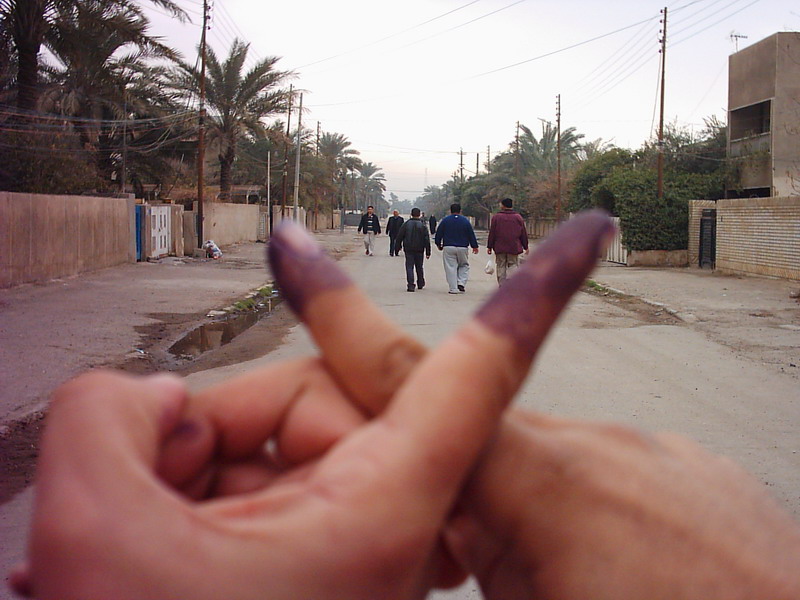
As someone who believed, hoped, worried, prayed, worried, hoped and prayed some more that Iraqis could one day pull off the election they did, I am unreservedly happy about the outcome - and you should be, too.
Why? Because what threatens America most from the Middle East are the pathologies of a region where there is too little freedom and too many young people who aren't able to achieve their full potential. The only way to cure these pathologies is with a war of ideas within the Arab-Muslim world so those with bad ideas can be defeated by those with progressive ones.
We can't fight that war. Only the Arab progressives can - only they can tell the suicide bombers that what they are doing is shameful to Islam and to Arabs. But we can collaborate with them to create a space in the heart of their world where decent people have a chance to fight this war - and that is what American and British soldiers have been doing in Iraq.
President Bush's basic gut instinct about the need to do this is exactly right. His thinking that this could be done on the cheap, though, with little postwar planning, was exactly wrong. Partly as a result, this great moment has already cost America over $100 billion and 10,000 killed and wounded.
That is not sustainable because the road ahead in Iraq is still long. We have to proceed with more wisdom and more allies. But proceed we must, and now we can at least do so with the certainty that partnering with the Iraqi people to build a decent consensual government is not crazy - it's really difficult, but not crazy.
But wait - not everyone is wearing a smiley face after the Iraqi elections, and that is good, considering who is unhappy. Let's start with the mullahs in Iran. Those who think that a Shiite-led government in Iraq is going to be the puppet of Iran's Shiite ayatollahs are so wrong. It is the ayatollahs in Iran who are terrified today. You see, the Iranian mullahs and their diplomats like to peddle the notion that they have their own form of democracy: "Islamic democracy." But this is a fraud, and the people who know best that it's a fraud are the ayatollahs and the Iranian people.
When any Iranian reform candidate who wants to run can be vetoed by unelected ayatollahs, and any Iranian newspaper can be shut by the same theocrats, that is not democracy. You can call that whatever you want, but not democracy. They don't allow bikinis at nudist colonies and they don't serve steak at vegetarian restaurants, and theocrats don't veto candidates in real democracies. The Iraqi Shiites just gave every Iranian Shiite next door a demonstration of what real "Islamic" democracy is: it's when Muslims vote for anyone they want. I just want to be around for Iran's next election, when the ayatollahs try to veto reform candidates and Iranian Shiites ask, Why can't we vote for anyone, like Iraqi Shiites did? Oh, boy, that's going to be pay-per-view.
Then there is Abu Musab al-Zarqawi. This Charles-Manson-with-a-turban who heads the insurgency in Iraq had a bad hair day on Sunday. I wonder whether anyone told him about the suicide bomber who managed to blow up only himself outside a Baghdad polling station and how Iraqi voters walked around his body, spitting on it as they went by. Zarqawi claims to be the leader of the Iraqi Vietcong - the authentic carrier of Iraqis' national aspirations and desire to liberate their country from "U.S. occupation." In truth, he is the leader of the Iraqi Khmer Rouge - a murderous death cult.
The election has exposed this. Because the Iraqi people have now made it clear that they are the authentic carriers of their national aspirations, and while, yes, they want an end to the U.S. presence, they want that end to happen in an orderly manner and in tandem with an Iraqi constitutional process.
In other words, this election has made it crystal clear that the Iraq war is not between fascist insurgents and America, but between the fascist insurgents and the Iraqi people. One hopes the French and Germans, whose newspapers often sound more like Al Jazeera than Al Jazeera, will wake up to this fact and throw their weight onto the right side of history.
It's about time, because whatever you thought about this war, it's not about Mr. Bush any more. It's about the aspirations of the Iraqi majority to build an alternative to Saddamism. By voting the way they did, in the face of real danger, Iraqis have earned the right to ask everyone now to put aside their squabbles and focus on what is no longer just a pipe dream but a real opportunity to implant decent, consensual government in the heart of the Arab-Muslim world.
By THOMAS L. FRIEDMAN
As someone who believed, hoped, worried, prayed, worried, hoped and prayed some more that Iraqis could one day pull off the election they did, I am unreservedly happy about the outcome - and you should be, too.
Why? Because what threatens America most from the Middle East are the pathologies of a region where there is too little freedom and too many young people who aren't able to achieve their full potential. The only way to cure these pathologies is with a war of ideas within the Arab-Muslim world so those with bad ideas can be defeated by those with progressive ones.
We can't fight that war. Only the Arab progressives can - only they can tell the suicide bombers that what they are doing is shameful to Islam and to Arabs. But we can collaborate with them to create a space in the heart of their world where decent people have a chance to fight this war - and that is what American and British soldiers have been doing in Iraq.
President Bush's basic gut instinct about the need to do this is exactly right. His thinking that this could be done on the cheap, though, with little postwar planning, was exactly wrong. Partly as a result, this great moment has already cost America over $100 billion and 10,000 killed and wounded.
That is not sustainable because the road ahead in Iraq is still long. We have to proceed with more wisdom and more allies. But proceed we must, and now we can at least do so with the certainty that partnering with the Iraqi people to build a decent consensual government is not crazy - it's really difficult, but not crazy.
But wait - not everyone is wearing a smiley face after the Iraqi elections, and that is good, considering who is unhappy. Let's start with the mullahs in Iran. Those who think that a Shiite-led government in Iraq is going to be the puppet of Iran's Shiite ayatollahs are so wrong. It is the ayatollahs in Iran who are terrified today. You see, the Iranian mullahs and their diplomats like to peddle the notion that they have their own form of democracy: "Islamic democracy." But this is a fraud, and the people who know best that it's a fraud are the ayatollahs and the Iranian people.
When any Iranian reform candidate who wants to run can be vetoed by unelected ayatollahs, and any Iranian newspaper can be shut by the same theocrats, that is not democracy. You can call that whatever you want, but not democracy. They don't allow bikinis at nudist colonies and they don't serve steak at vegetarian restaurants, and theocrats don't veto candidates in real democracies. The Iraqi Shiites just gave every Iranian Shiite next door a demonstration of what real "Islamic" democracy is: it's when Muslims vote for anyone they want. I just want to be around for Iran's next election, when the ayatollahs try to veto reform candidates and Iranian Shiites ask, Why can't we vote for anyone, like Iraqi Shiites did? Oh, boy, that's going to be pay-per-view.
Then there is Abu Musab al-Zarqawi. This Charles-Manson-with-a-turban who heads the insurgency in Iraq had a bad hair day on Sunday. I wonder whether anyone told him about the suicide bomber who managed to blow up only himself outside a Baghdad polling station and how Iraqi voters walked around his body, spitting on it as they went by. Zarqawi claims to be the leader of the Iraqi Vietcong - the authentic carrier of Iraqis' national aspirations and desire to liberate their country from "U.S. occupation." In truth, he is the leader of the Iraqi Khmer Rouge - a murderous death cult.
The election has exposed this. Because the Iraqi people have now made it clear that they are the authentic carriers of their national aspirations, and while, yes, they want an end to the U.S. presence, they want that end to happen in an orderly manner and in tandem with an Iraqi constitutional process.
In other words, this election has made it crystal clear that the Iraq war is not between fascist insurgents and America, but between the fascist insurgents and the Iraqi people. One hopes the French and Germans, whose newspapers often sound more like Al Jazeera than Al Jazeera, will wake up to this fact and throw their weight onto the right side of history.
It's about time, because whatever you thought about this war, it's not about Mr. Bush any more. It's about the aspirations of the Iraqi majority to build an alternative to Saddamism. By voting the way they did, in the face of real danger, Iraqis have earned the right to ask everyone now to put aside their squabbles and focus on what is no longer just a pipe dream but a real opportunity to implant decent, consensual government in the heart of the Arab-Muslim world.
Wednesday, February 02, 2005
President Bush's State of the Union Address
The following is the transcript of the State of the Union Address as recorded by Federal News Service.
PRESIDENT BUSH: Mr. Speaker, Vice President Cheney, members of Congress, fellow citizens, as a new Congress gathers, all of us in the elected branches of government share a great privilege. We've been placed in office by the votes of the people we serve. And tonight, that is a privilege we share with newly elected leaders of Afghanistan, the Palestinian territories, Ukraine, and a free and sovereign Iraq. (Cheers, applause.)
Two weeks ago I stood on the steps of this Capitol and renewed the commitment of our nation to the guiding ideal of liberty for all. This evening I will set forth policies to advance that ideal at home and around the world. Tonight, with a healthy, growing economy, with more Americans going back to work, with our nation an active force for good in the world, the state of our union is confident and strong. (Applause.)
Our generation has been blessed by the expansion of opportunity, by advances in medicine, by the security purchased by our parents' sacrifice. Now, as we see a little gray in the mirror -- or a lot of gray -- (laughter) -- and we watch our children moving into adulthood, we ask the question, what will be the state of their union? Members of Congress, the choices we make together will answer that question. Over the next several months, on issue after issue, let us do what Americans have always done and build a better world for our children and our grandchildren. (Applause.)
First, we must be good stewards of this economy and renew the great institutions on which millions of our fellow citizens rely. America's economy is the fastest growing of any major industrialized nation. In the past four years we've provided tax relief to every person who pays income taxes, overcome a recession, opened up new markets abroad, prosecuted corporate criminals, raised homeownership to its highest level in history, and in the last year alone the United States has added 2.3 million new jobs. (Cheers, applause.)
When action was needed, the Congress delivered, and the nation is grateful. Now we must add to these achievements. By making our economy more flexible, more innovative, and more competitive, we will keep America the economic leader of the world. (Applause.)
America's prosperity requires restraining the spending appetite of the federal government. I welcome the bipartisan enthusiasm for spending discipline. I will send you a budget that holds the growth of discretionary spending below inflation, makes tax relief permanent, and stays on track to cut the deficit in half by 2009. (Applause.)
My budget substantially reduces or eliminates more than 150 government programs that are not getting results or duplicate current efforts or do not fulfill essential priorities.
The principle here is clear: Taxpayer dollars must be spent wisely or not at all. (Applause.)
To make our economy stronger and more dynamic, we must prepare a rising generation to fill the jobs of the 21st century. Under the No Child Left Behind Act, standards are higher, test scores are on the rise, and we're closing the achievement gap for minority students. Now we must demand better results from our high schools so every high school diploma is a ticket to success.
We will help an additional 200,000 workers to get training for a better career by reforming our job training system and strengthening America's community colleges. And we will make it easier for Americans to afford a college education by increasing the size of Pell grants. (Applause.)
To make our economy stronger and more competitive, America must reward, not punish, the efforts and dreams of entrepreneurs. Small business is the path of advancement, especially for women and minorities. So we must free small businesses from needless regulation and protection honest job creators from junk lawsuits. (Applause.)
Justice is distorted and our economy is held back by irresponsible class actions and frivolous asbestos claims, and I urge Congress to pass legal reforms this year. (Applause.)
To make our economy stronger and more productive, we must make health care more affordable and give families greater access to good coverage -- (applause) -- and more control over their health decisions. (Applause.)
I -- I ask Congress to move forward on a comprehensive health care agenda with tax credits to help low-income workers buy insurance, a community health center in every poor country, improved information technology to prevent medical error and needless costs, association health plans for small business and their employees -- (cheers, applause) -- expanded health savings accounts -- (cheers, applause) -- and medical liability reform that will reduce health care costs and make sure patients have the doctors and care they need. (Cheers, applause.)
To keep our economy growing, we also need reliable supplies of affordable, environmentally responsible energy. (Cheers, applause.)
Nearly four years ago, I submitted a comprehensive energy strategy that encourages conservation, alternative sources, a modernized electricity grid, and more production here at home, including safe, clean nuclear energy. (Applause.)
My Clear Skies legislation will cut power plant pollution and improve the health of our citizens. (Applause.) And my budget provides strong funding for leading-edge technology, from hydrogen- fueled cars to clean coal to renewable sources such as ethanol. (Applause.) Four years of debate is enough! (Cheers.) I urge Congress to pass legislation that makes America more secure and less dependent on foreign energy. (Cheers, applause.)
All these proposals are essential to expand this economy and add new jobs, but they are just the beginning of our duty. To build the prosperity of future generations, we must update institutions that were created to meet the needs of an earlier time.
Year after year, Americans are burdened by an archaic, incoherent federal tax code. I've appointed a bipartisan panel to examine the tax code from top to bottom. And when the recommendations are delivered, you and I will work together to give this nation a tax code that is pro-growth, easy to understand and fair to all. (Applause.)
America's immigration system is also outdated, unsuited to the needs of our economy and to the values of our country. We should not be content with laws that punish hardworking people who want only to provide for their families -- (scattered applause) -- and deny businesses willing workers and invite chaos at our border. It is time for an immigration policy that permits temporary guest workers to fill jobs Americans will not take, that rejects amnesty, that tells us who is entering and leaving our country, and that closes the border to drug dealers and terrorists. (Applause.)
One of America's most important institutions, a symbol of the trust between generations, is also in need of wise and effective reform. Social Security was a great moral success of the 20th century, and we must honor its great purposes in this new century. (Applause.)
The system, however, on its current path, is headed toward bankruptcy, and so we must join together to strengthen and save Social Security. (Cheers, applause.)
Today, more than 45 million Americans receive Social Security benefits, and millions more are nearing retirement. And for them, the system is strong and fiscally sound. I have a message for every American who is 55 or older: Do not let anyone mislead you. For you, the Social Security system will not change in any way. (Applause.)
For younger workers, the Social Security system has serious problems that will grow worse with time.
Social Security was created decades ago, for a very different era. In those days people didn't live as long, benefits were much lower than they are today, and a half century ago, about 16 workers paid into the system for each person drawing benefits. Our society has changed in ways the founders of Social Security could not have foreseen. In today's world, people are living longer, and therefore drawing benefits longer -- and those benefits are scheduled to rise dramatically over the next few decades. (Scattered applause.) And instead of 16 workers paying in for every beneficiary, right now it's only about three workers. And over the next few decades, that number will fall to just two workers per beneficiary. With each passing year, fewer workers are paying ever-higher benefits to an ever-larger number of retirees.
So here is the result. Thirteen years from now, in 2018, Social Security will be paying out more than it takes in. And every year afterward will bring a new shortfall, bigger than the year before. For example, in the year 2027, the government will somehow have to come up with an extra $200 billion to keep the system afloat.
And by 2033, the annual shortfall would be more than $300 billion. By the year 2042, the entire system would be exhausted and bankrupt. (Noes are heard.) If steps are not taken to avert that outcome, the only solutions would be dramatically higher taxes, massive new borrowing, or sudden and severe cuts in Social Security benefits or other government programs. (Noes are heard.)
I recognize that 2018 and 2042 may seem a long way off, but those dates aren't so distant, as any parent will tell you. If you have a five-year-old, you're already concerned about how you'll pay for college tuition 13 years down the road. If you've got children in their 20s, as some of us do, the idea of Social Security collapsing before they retire does not seem like a small matter. And it should not be a small matter to the United States Congress. (Cheers, applause.)
You and I share a responsibility. We must pass reforms that solve the financial problems of Social Security once and for all.
Fixing Social Security permanently will require an open, candid review of the options. Some have suggested limiting benefits for wealthy retirees. Former Congressman Tim Penny has raised the possibility of indexing benefits to prices rather than wages. During the 1990s, my predecessor, President Clinton, spoke of increasing the retirement age. Former Senator John Breaux suggested discouraging early collection of Social Security benefits. The late Senator Daniel Patrick Moynihan recommended changing the way benefits are calculated.
All these ideas are on the table. I know that none of these reforms would be easy. But we have to move ahead with courage and honesty, because our children's retirement security is more important than partisan politics. (Applause.)
I will work with members of Congress to find the most effective combination of reforms. I will listen to anyone who has a good idea to offer. (Cheers, applause.) We must, however, be guided by some basic principles. We must make Social Security permanently sound, not leave that task for another day. We must not jeopardize our economic strength by increasing payroll taxes. We must ensure that lower- income Americans get the help they need to have dignity and peace of mind in their retirement. We must guarantee that there is no change for those now retired or nearing retirement. And we must take care that any changes in the system are gradual, so younger workers have years to prepare and plan for their future.
As we fix Social Security, we also have the responsibility to make the system a better deal for younger workers, and the best way to reach that goal is through voluntary personal retirement accounts. (Applause.)
Here's how the idea works. Right now, a set portion of the money you earn is taken out of your paycheck to pay for the Social Security benefits of today's retirees. If you are a younger worker, I believe you should be able to set aside part of that money in your own retirement account, so you can build a nest egg for your own future.
Here is why personal accounts are a better deal. Your money will grow, over time, at a greater rate than anything the current system can deliver, and your account will provide money for retirement over and above the check you will receive from Social Security. In addition, you'll be able to pass along the money that accumulates in your personal account, if you wish, to your children and -- or grandchildren. And best of all, the money in the account is yours, and the government can never take it away. (Cheers, applause.)
The goal here is greater security in retirement, so we will set careful guidelines for personal accounts. We will make sure the money can only go into a conservative mix of bonds and stock funds. We will make sure that your earnings are not eaten up by hidden Wall Street fees. We will make sure there are good options to protect your investments from sudden market swings on the eve of your retirement.
We'll make sure a personal account cannot be emptied out all at once, but rather paid out over time, as an addition to traditional Social Security benefits. And we will make sure this plan is fiscally responsible, by starting personal retirement accounts gradually, and raising the yearly limits on contributions over time, eventually permitting all workers to set aside 4 percentage points of their payroll taxes in their accounts.
Personal retirement accounts should be familiar to federal employees because you already have something similar called the Thrift Savings Plan, which lets workers deposit a portion of their paychecks into any of five different broadly based investment funds. It's time to extend the same security, and choice, and ownership to young Americans. (Cheers, applause.)
Our second great responsibility to our children and grandchildren is to honor and to pass along the values that sustain a free society. So many of my generation, after a long journey, have come home to family and faith and are determined to bring up responsible, moral children. Government is not the source of these values, but government should never undermine them.
Because marriage is a sacred institution and the foundation of society, it should not be redefined by activist judges. For the good of families, children and society, I support a constitutional amendment to protect the institution of marriage. (Cheers, applause.)
Because a society is measured by how it treats the weak and vulnerable, we must strive to build a culture of life.
Medical research can help us reach that goal by developing treatments and cures that save lives and help people overcome disabilities, and I thank Congress for doubling the funding of the National Institutes of Health. (Applause.)
To build a culture of life, we must also ensure that scientific advances always serve human dignity, not take advantage of some lives for the benefit of others. (Applause.) We should all be able to agree -- (applause) -- we should all be able to agree on some clear standards. I will work with Congress to ensure that human embryos are not created for experimentation or grown for body parts, and that human life is never bought or sold as a commodity. (Applause.)
America will continue to lead the world in medical research that is ambitious, aggressive and always ethical.
Because courts must always deliver impartial justice, judges have a duty to faithfully interpret the law, not legislate from the bench. (Applause.) As president, I have a constitutional responsibility to nominate men and women who understand the role of courts in our democracy and are well qualified to serve on the bench, and I have done so. (Applause.)
The Constitution also gives the Senate a responsibility: Every judicial nominee deserves an up-or-down vote. (Cheers, applause.)
Because one of the deepest values of our country is compassion, we must never turn away from any citizen who feels isolated from the opportunities of America. Our government will continue to support faith-based and community groups that bring hope to harsh places.
Now we need to focus on giving young people, especially young men in our cities, better options than apathy, or gangs, or jail. Tonight I propose a three-year initiative to help organizations keep young people out of gangs, and show young men an ideal of manhood that respects women and rejects violence. (Applause.)
Taking on gang life will be one part of a broader outreach to at- risk youth which involves parents and pastors, coaches and community leaders, in programs ranging from literacy to sports. And I am proud that the leader of this nationwide effort will be our First Lady, Laura Bush. (Cheers, applause.)
Because HIV/AIDS brings suffering and fear into so many lives, I ask you to reauthorize the Ryan White Act to encourage prevention, and provide care and treatment to the victims of that disease. (Applause.)
And as we update this important law, we must focus our efforts on fellow citizens with the highest rates of new cases, African-American men and women. (Applause.) Because one of the main sources of our national unity is our belief in equal justice, we need to make sure Americans of all races and backgrounds have confidence in the system that provides justice.
In America, we must make doubly sure no person is held to account for a crime he or she did not commit, so we are dramatically expanding the use of DNA evidence to prevent wrongful conviction. (Applause.) Soon I will send to Congress a proposal to fund special training for defense counsel in capital cases because people on trial for their lives must have competent lawyers by their side. (Applause.)
Our third responsibility to future generations is to leave them an America that is safe from danger and protected by peace. We will pass along to our children all the freedoms we enjoy; and chief among them is freedom from fear.
In the three and a half years since September 11th, 2001, we've taken unprecedented actions to protect Americans. We've created a new department of government to defend our homeland, focused the FBI on preventing terrorism, begun to reform our intelligence agencies, broken up terror cells across the country, expanded research on defenses against biological and chemical attack, improved border security, and trained more than a half million first responders.
Police and firefighters, air marshals, researchers and so many others are working every day to make our homeland safer, and we thank them all. (Extended applause.)
Our nation, working with allies and friends, has also confronted the enemy abroad, with measures that are determined, successful and continuing. The al Qaeda terror network that attacked our country still has leaders, but many of its top commanders have been removed. There are still governments that sponsor and harbor terrorists, but their number has declined. There are still regimes seeking weapons of mass destruction, but no longer without attention and without consequence. Our country is still the target of terrorists who want to kill many and intimidate us all, and we will stay on the offensive against them until the fight is won. (Cheers, applause.)
Pursuing our enemies is a vital commitment of the war on terror, and I thank the Congress for providing our servicemen and -women with the resources they have needed.
During this time of war, we must continue to support our military and give them the tools for victory. (Applause.)
Other nations around the globe have stood with us. In Afghanistan, an international force is helping provide security. In Iraq, 28 countries have troops on the ground, the United Nations and the European Union provided technical assistance for the elections, and NATO is leading a mission to help train Iraqi officers.
We're cooperating with 60 governments in the Proliferation Security Initiative to detect and stop the transit of dangerous materials. We're working closely with governments in Asia to convince North Korea to abandon its nuclear ambitions.
Pakistan, Saudi Arabia, and nine other countries have captured or detained al-Qaeda terrorists.
In the next four years, my administration will continue to build the coalitions that will defeat the dangers of our time. (Applause.)
In the long term, the peace we seek will only be achieved by eliminating the conditions that feed radicalism and ideologies of murder. If whole regions of the world remain in despair and grow in hatred, they will be the recruiting grounds for terror, and that terror will stalk America and other free nations for decades. The only force powerful enough to stop the rise of tyranny and terror, and replace hatred with hope, is the force of human freedom. (Cheers, applause.)
Our enemies know this, and that is why the terrorist Zarqawi recently declared war on what he called the "evil principle" of democracy. And we've declared our own intention: America will stand with the allies of freedom to support democratic movements in the Middle East and beyond, with the ultimate goal of ending tyranny in our world. (Applause.)
The United States has no right, no desire and no intention to impose our form of government on anyone else. That is one -- (applause) -- that is one of the main differences between us and our enemies. They seek to impose and expand an empire of oppression, in which a tiny group of brutal, self-appointed rulers control every aspect of every life. Our aim is to build and preserve a community of free and independent nations, with governments that answer to their citizens and reflect their own cultures.
And because democracies respect their own people and their neighbors, the advance of freedom will lead to peace. (Applause.)
That advance has great momentum in our time, shown by women voting in Afghanistan and Palestinians choosing a new direction, and the people of Ukraine asserting their democratic rights and electing a president. We are witnessing landmark events in the history of liberty, and in the coming years, we will add to that story. (Cheers, applause.)
The beginnings of reform and democracy in the Palestinian territories are now showing the power of freedom to break old patterns of violence and failure. Tomorrow morning, Secretary of State Rice departs on a trip that will take her to Israel and the West Bank for meetings with Prime Minister Sharon and President Abbas. She will discuss with them how we and our friends can help the Palestinian people end terror and build the institutions of a peaceful, independent democratic state.
To promote this democracy, I will ask Congress for $350 million to support Palestinian political, economic, and security reforms. The goal of two democratic states, Israel and Palestine, living side by side in peace is within reach -- and America will help them achieve that goal. (Applause.)
To promote peace and stability in the broader Middle East, the United States will work with our friends in the region to fight the common threat of terror, while we encourage a higher standard of freedom. Hopeful reform is already taking hold in an arc from Morocco to Jordan to Bahrain. The government of Saudi Arabia can demonstrate its leadership in the region by expanding the role of its people in determining their future. And the great and proud nation of Egypt, which showed the way toward peace in the Middle East, can now show the way toward democracy in the Middle East. (Applause.)
To promote peace in the broader Middle East, we must confront regimes that continue to harbor terrorists and pursue weapons of mass murder. Syria still allows its territory, and parts of Lebanon, to be used by terrorists who seek to destroy every chance of peace in the region.
You have passed, and we are applying, the Syrian Accountability Act, and we expect the Syrian government to end all support for terror and open the door to freedom. (Applause.)
Today, Iran remains the world's primary state sponsor of terror, pursuing nuclear weapons while depriving its people of the freedom they seek and deserve. We are working with European allies to make clear to the Iranian regime that it must give up its uranium enrichment program and any plutonium reprocessing and end its support for terror. And to the Iranian people, I say tonight: As you stand for your own liberty, America stands with you. (Cheers, applause.)
Our generational commitment to the advance of freedom, especially in the Middle East, is now being tested and honored in Iraq. That country is a vital front in the war on terror, which is why the terrorists have chosen to make a stand there. Our men and women in uniform are fighting terrorists in Iraq so we do not have to face them here at home. (Applause.)
The victory of freedom in Iraq will strengthen a new ally in the war on terror, inspire democratic reformers from Damascus to Tehran, bring more hope and progress to a troubled region, and thereby lift a terrible threat from the lives of our children and grandchildren.
We will succeed because the Iraqi people value their own liberty -- as they showed the world last Sunday. (Cheers, applause.) Across Iraq, often at great risk, millions of citizens went to the polls and elected 275 men and women to represent them in a new Transitional National Assembly. A young woman in Baghdad told of waking to the sound of mortar fire on election day and wondering if it might be too dangerous to vote.
She said, "Hearing those explosions, it occurred to me: the insurgents are weak, they are afraid of democracy, they are losing. So I got my husband and I got my parents, and we all came out and voted together."
Americans recognize that spirit of liberty, because we share it. In any nation, casting your vote is an act of civic responsibility. For millions of Iraqis, it was also an act of personal courage, and they have earned the respect of us all. (Applause.)
One of Iraq's leading democracy and human rights advocates is Safia Taleb al-Suhail. She says of her country, "We were occupied for 35 years by Saddam Hussein. That was the real occupation. Thank you to the American people who paid the cost, but most of all to the soldiers."
Eleven years ago, Safia's father was assassinated by Saddam's intelligence service. Three days ago in Baghdad, Safia was finally able to vote for the leaders of her country. And we are honored that she is with us tonight. (Extended cheers and applause.)
The terrorists and insurgents are violently opposed to democracy, and will continue to attack it. Yet the terrorists' most powerful myth is being destroyed. The whole world is seeing that the car bombers and assassins are not only fighting coalition forces, they are trying to destroy the hopes of Iraqis, expressed in free elections. And the whole world now knows that a small group of extremists will not overturn the will of the Iraqi people. (Cheers, applause.)
We will succeed in Iraq because Iraqis are determined to fight for their own freedom and to write their own history. As Prime Minister Allawi said in his speech to Congress last September, "Ordinary Iraqis are anxious" to "shoulder all the security burdens of our country as quickly as possible." This is the natural desire of an independent nation, and it also is the stated mission of our coalition in Iraq.
The new political situation in Iraq opens a new phase of our work in that country. At the recommendation of our commanders on the ground, and in consultation with the Iraqi government, we will increasingly focus our efforts on helping prepare more capable Iraqi security forces, forces with skilled officers and an effective command structure.
As those forces become more self-reliant and take on greater security responsibilities, America and its coalition partners will increasingly be in a supporting role. In the end, Iraqis must be able to defend their own country -- and we will help that proud, new nation secure its liberty.
Recently, an Iraqi interpreter said to a reporter, "Tell America not to abandon us." He and all Iraqis can be certain: While our military strategy is adapting to circumstances, our commitment remains firm and unchanging. We are standing for the freedom of our Iraqi friends, and freedom in Iraq will make America safer for generations to come. (Cheers, applause.)
We will not set an artificial timetable for leaving Iraq because that would embolden the terrorists and make them believe they can wait us out. We are in Iraq to achieve a result: a country that is democratic, representative of all its people, at peace with its neighbors, and able to defend itself.
And when that result is achieved, our men and women serving in Iraq will return home with the honor they have earned. (Applause.)
Right now, Americans in uniform are serving at posts across the world, often taking great risks, on my orders. We have given them training and equipment, and they have given us an example of idealism and character that makes every American proud. (Applause.) The volunteers of our military are unrelenting in battle, unwavering in loyalty, unmatched in honor and decency, and every day they are making our nation more secure.
Some of our servicemen and women have survived terrible injuries, and this grateful nation will do everything we can to help them recover. (Applause.)
And we have said farewell to some very good men and women, who died for our freedom and whose memory this nation will honor forever. One name we honor is Marine Corps Sergeant Byron Norwood of Pflugerville, Texas, who was killed during the assault on Fallujah. His mom, Janet, sent me a letter and told me how much Byron loved being a Marine and how proud he was to be on the front line against terror. She wrote, "When Byron was home the last time, I said that I wanted to protect him, like I had since he was born. He just hugged me and said, `You've done your job, Mom. Now it is my turn to protect you.'"
Ladies and gentlemen, with grateful hearts, we honor freedom's defenders and our military families, represented here this evening by Sergeant Norwood's mom and dad, Janet and Bill Norwood. (Extended applause and cheers.)
In these four years, Americans have seen the unfolding of large events. We have known times of sorrow and hours of uncertainty and days of victory. In all this history, even when we have disagreed, we have seen threads of purpose that unite us. The attack on freedom in our world has reaffirmed our confidence in freedom's power to change the world. We are all part of a great venture: to extend the promise of freedom in our country, to renew the values that sustain our liberty, and to spread the peace that freedom brings.
As Franklin Roosevelt once reminded Americans, "each age is a dream that is dying, or one that is coming to birth." And we live in the country where the biggest dreams are born. The abolition of slavery was only a dream, until it was fulfilled.
The liberation of Europe from fascism was only a dream -- until it was achieved. The fall of imperial communism was only a dream -- until one day it was accomplished.
Our generation has dreams of its own, and we also go forward with confidence. The road of Providence is uneven and unpredictable -- yet we know where it leads: It leads to freedom.
Thank you, and may God bless America. (Cheers, applause.)
The following is the transcript of the State of the Union Address as recorded by Federal News Service.
PRESIDENT BUSH: Mr. Speaker, Vice President Cheney, members of Congress, fellow citizens, as a new Congress gathers, all of us in the elected branches of government share a great privilege. We've been placed in office by the votes of the people we serve. And tonight, that is a privilege we share with newly elected leaders of Afghanistan, the Palestinian territories, Ukraine, and a free and sovereign Iraq. (Cheers, applause.)
Two weeks ago I stood on the steps of this Capitol and renewed the commitment of our nation to the guiding ideal of liberty for all. This evening I will set forth policies to advance that ideal at home and around the world. Tonight, with a healthy, growing economy, with more Americans going back to work, with our nation an active force for good in the world, the state of our union is confident and strong. (Applause.)
Our generation has been blessed by the expansion of opportunity, by advances in medicine, by the security purchased by our parents' sacrifice. Now, as we see a little gray in the mirror -- or a lot of gray -- (laughter) -- and we watch our children moving into adulthood, we ask the question, what will be the state of their union? Members of Congress, the choices we make together will answer that question. Over the next several months, on issue after issue, let us do what Americans have always done and build a better world for our children and our grandchildren. (Applause.)
First, we must be good stewards of this economy and renew the great institutions on which millions of our fellow citizens rely. America's economy is the fastest growing of any major industrialized nation. In the past four years we've provided tax relief to every person who pays income taxes, overcome a recession, opened up new markets abroad, prosecuted corporate criminals, raised homeownership to its highest level in history, and in the last year alone the United States has added 2.3 million new jobs. (Cheers, applause.)
When action was needed, the Congress delivered, and the nation is grateful. Now we must add to these achievements. By making our economy more flexible, more innovative, and more competitive, we will keep America the economic leader of the world. (Applause.)
America's prosperity requires restraining the spending appetite of the federal government. I welcome the bipartisan enthusiasm for spending discipline. I will send you a budget that holds the growth of discretionary spending below inflation, makes tax relief permanent, and stays on track to cut the deficit in half by 2009. (Applause.)
My budget substantially reduces or eliminates more than 150 government programs that are not getting results or duplicate current efforts or do not fulfill essential priorities.
The principle here is clear: Taxpayer dollars must be spent wisely or not at all. (Applause.)
To make our economy stronger and more dynamic, we must prepare a rising generation to fill the jobs of the 21st century. Under the No Child Left Behind Act, standards are higher, test scores are on the rise, and we're closing the achievement gap for minority students. Now we must demand better results from our high schools so every high school diploma is a ticket to success.
We will help an additional 200,000 workers to get training for a better career by reforming our job training system and strengthening America's community colleges. And we will make it easier for Americans to afford a college education by increasing the size of Pell grants. (Applause.)
To make our economy stronger and more competitive, America must reward, not punish, the efforts and dreams of entrepreneurs. Small business is the path of advancement, especially for women and minorities. So we must free small businesses from needless regulation and protection honest job creators from junk lawsuits. (Applause.)
Justice is distorted and our economy is held back by irresponsible class actions and frivolous asbestos claims, and I urge Congress to pass legal reforms this year. (Applause.)
To make our economy stronger and more productive, we must make health care more affordable and give families greater access to good coverage -- (applause) -- and more control over their health decisions. (Applause.)
I -- I ask Congress to move forward on a comprehensive health care agenda with tax credits to help low-income workers buy insurance, a community health center in every poor country, improved information technology to prevent medical error and needless costs, association health plans for small business and their employees -- (cheers, applause) -- expanded health savings accounts -- (cheers, applause) -- and medical liability reform that will reduce health care costs and make sure patients have the doctors and care they need. (Cheers, applause.)
To keep our economy growing, we also need reliable supplies of affordable, environmentally responsible energy. (Cheers, applause.)
Nearly four years ago, I submitted a comprehensive energy strategy that encourages conservation, alternative sources, a modernized electricity grid, and more production here at home, including safe, clean nuclear energy. (Applause.)
My Clear Skies legislation will cut power plant pollution and improve the health of our citizens. (Applause.) And my budget provides strong funding for leading-edge technology, from hydrogen- fueled cars to clean coal to renewable sources such as ethanol. (Applause.) Four years of debate is enough! (Cheers.) I urge Congress to pass legislation that makes America more secure and less dependent on foreign energy. (Cheers, applause.)
All these proposals are essential to expand this economy and add new jobs, but they are just the beginning of our duty. To build the prosperity of future generations, we must update institutions that were created to meet the needs of an earlier time.
Year after year, Americans are burdened by an archaic, incoherent federal tax code. I've appointed a bipartisan panel to examine the tax code from top to bottom. And when the recommendations are delivered, you and I will work together to give this nation a tax code that is pro-growth, easy to understand and fair to all. (Applause.)
America's immigration system is also outdated, unsuited to the needs of our economy and to the values of our country. We should not be content with laws that punish hardworking people who want only to provide for their families -- (scattered applause) -- and deny businesses willing workers and invite chaos at our border. It is time for an immigration policy that permits temporary guest workers to fill jobs Americans will not take, that rejects amnesty, that tells us who is entering and leaving our country, and that closes the border to drug dealers and terrorists. (Applause.)
One of America's most important institutions, a symbol of the trust between generations, is also in need of wise and effective reform. Social Security was a great moral success of the 20th century, and we must honor its great purposes in this new century. (Applause.)
The system, however, on its current path, is headed toward bankruptcy, and so we must join together to strengthen and save Social Security. (Cheers, applause.)
Today, more than 45 million Americans receive Social Security benefits, and millions more are nearing retirement. And for them, the system is strong and fiscally sound. I have a message for every American who is 55 or older: Do not let anyone mislead you. For you, the Social Security system will not change in any way. (Applause.)
For younger workers, the Social Security system has serious problems that will grow worse with time.
Social Security was created decades ago, for a very different era. In those days people didn't live as long, benefits were much lower than they are today, and a half century ago, about 16 workers paid into the system for each person drawing benefits. Our society has changed in ways the founders of Social Security could not have foreseen. In today's world, people are living longer, and therefore drawing benefits longer -- and those benefits are scheduled to rise dramatically over the next few decades. (Scattered applause.) And instead of 16 workers paying in for every beneficiary, right now it's only about three workers. And over the next few decades, that number will fall to just two workers per beneficiary. With each passing year, fewer workers are paying ever-higher benefits to an ever-larger number of retirees.
So here is the result. Thirteen years from now, in 2018, Social Security will be paying out more than it takes in. And every year afterward will bring a new shortfall, bigger than the year before. For example, in the year 2027, the government will somehow have to come up with an extra $200 billion to keep the system afloat.
And by 2033, the annual shortfall would be more than $300 billion. By the year 2042, the entire system would be exhausted and bankrupt. (Noes are heard.) If steps are not taken to avert that outcome, the only solutions would be dramatically higher taxes, massive new borrowing, or sudden and severe cuts in Social Security benefits or other government programs. (Noes are heard.)
I recognize that 2018 and 2042 may seem a long way off, but those dates aren't so distant, as any parent will tell you. If you have a five-year-old, you're already concerned about how you'll pay for college tuition 13 years down the road. If you've got children in their 20s, as some of us do, the idea of Social Security collapsing before they retire does not seem like a small matter. And it should not be a small matter to the United States Congress. (Cheers, applause.)
You and I share a responsibility. We must pass reforms that solve the financial problems of Social Security once and for all.
Fixing Social Security permanently will require an open, candid review of the options. Some have suggested limiting benefits for wealthy retirees. Former Congressman Tim Penny has raised the possibility of indexing benefits to prices rather than wages. During the 1990s, my predecessor, President Clinton, spoke of increasing the retirement age. Former Senator John Breaux suggested discouraging early collection of Social Security benefits. The late Senator Daniel Patrick Moynihan recommended changing the way benefits are calculated.
All these ideas are on the table. I know that none of these reforms would be easy. But we have to move ahead with courage and honesty, because our children's retirement security is more important than partisan politics. (Applause.)
I will work with members of Congress to find the most effective combination of reforms. I will listen to anyone who has a good idea to offer. (Cheers, applause.) We must, however, be guided by some basic principles. We must make Social Security permanently sound, not leave that task for another day. We must not jeopardize our economic strength by increasing payroll taxes. We must ensure that lower- income Americans get the help they need to have dignity and peace of mind in their retirement. We must guarantee that there is no change for those now retired or nearing retirement. And we must take care that any changes in the system are gradual, so younger workers have years to prepare and plan for their future.
As we fix Social Security, we also have the responsibility to make the system a better deal for younger workers, and the best way to reach that goal is through voluntary personal retirement accounts. (Applause.)
Here's how the idea works. Right now, a set portion of the money you earn is taken out of your paycheck to pay for the Social Security benefits of today's retirees. If you are a younger worker, I believe you should be able to set aside part of that money in your own retirement account, so you can build a nest egg for your own future.
Here is why personal accounts are a better deal. Your money will grow, over time, at a greater rate than anything the current system can deliver, and your account will provide money for retirement over and above the check you will receive from Social Security. In addition, you'll be able to pass along the money that accumulates in your personal account, if you wish, to your children and -- or grandchildren. And best of all, the money in the account is yours, and the government can never take it away. (Cheers, applause.)
The goal here is greater security in retirement, so we will set careful guidelines for personal accounts. We will make sure the money can only go into a conservative mix of bonds and stock funds. We will make sure that your earnings are not eaten up by hidden Wall Street fees. We will make sure there are good options to protect your investments from sudden market swings on the eve of your retirement.
We'll make sure a personal account cannot be emptied out all at once, but rather paid out over time, as an addition to traditional Social Security benefits. And we will make sure this plan is fiscally responsible, by starting personal retirement accounts gradually, and raising the yearly limits on contributions over time, eventually permitting all workers to set aside 4 percentage points of their payroll taxes in their accounts.
Personal retirement accounts should be familiar to federal employees because you already have something similar called the Thrift Savings Plan, which lets workers deposit a portion of their paychecks into any of five different broadly based investment funds. It's time to extend the same security, and choice, and ownership to young Americans. (Cheers, applause.)
Our second great responsibility to our children and grandchildren is to honor and to pass along the values that sustain a free society. So many of my generation, after a long journey, have come home to family and faith and are determined to bring up responsible, moral children. Government is not the source of these values, but government should never undermine them.
Because marriage is a sacred institution and the foundation of society, it should not be redefined by activist judges. For the good of families, children and society, I support a constitutional amendment to protect the institution of marriage. (Cheers, applause.)
Because a society is measured by how it treats the weak and vulnerable, we must strive to build a culture of life.
Medical research can help us reach that goal by developing treatments and cures that save lives and help people overcome disabilities, and I thank Congress for doubling the funding of the National Institutes of Health. (Applause.)
To build a culture of life, we must also ensure that scientific advances always serve human dignity, not take advantage of some lives for the benefit of others. (Applause.) We should all be able to agree -- (applause) -- we should all be able to agree on some clear standards. I will work with Congress to ensure that human embryos are not created for experimentation or grown for body parts, and that human life is never bought or sold as a commodity. (Applause.)
America will continue to lead the world in medical research that is ambitious, aggressive and always ethical.
Because courts must always deliver impartial justice, judges have a duty to faithfully interpret the law, not legislate from the bench. (Applause.) As president, I have a constitutional responsibility to nominate men and women who understand the role of courts in our democracy and are well qualified to serve on the bench, and I have done so. (Applause.)
The Constitution also gives the Senate a responsibility: Every judicial nominee deserves an up-or-down vote. (Cheers, applause.)
Because one of the deepest values of our country is compassion, we must never turn away from any citizen who feels isolated from the opportunities of America. Our government will continue to support faith-based and community groups that bring hope to harsh places.
Now we need to focus on giving young people, especially young men in our cities, better options than apathy, or gangs, or jail. Tonight I propose a three-year initiative to help organizations keep young people out of gangs, and show young men an ideal of manhood that respects women and rejects violence. (Applause.)
Taking on gang life will be one part of a broader outreach to at- risk youth which involves parents and pastors, coaches and community leaders, in programs ranging from literacy to sports. And I am proud that the leader of this nationwide effort will be our First Lady, Laura Bush. (Cheers, applause.)
Because HIV/AIDS brings suffering and fear into so many lives, I ask you to reauthorize the Ryan White Act to encourage prevention, and provide care and treatment to the victims of that disease. (Applause.)
And as we update this important law, we must focus our efforts on fellow citizens with the highest rates of new cases, African-American men and women. (Applause.) Because one of the main sources of our national unity is our belief in equal justice, we need to make sure Americans of all races and backgrounds have confidence in the system that provides justice.
In America, we must make doubly sure no person is held to account for a crime he or she did not commit, so we are dramatically expanding the use of DNA evidence to prevent wrongful conviction. (Applause.) Soon I will send to Congress a proposal to fund special training for defense counsel in capital cases because people on trial for their lives must have competent lawyers by their side. (Applause.)
Our third responsibility to future generations is to leave them an America that is safe from danger and protected by peace. We will pass along to our children all the freedoms we enjoy; and chief among them is freedom from fear.
In the three and a half years since September 11th, 2001, we've taken unprecedented actions to protect Americans. We've created a new department of government to defend our homeland, focused the FBI on preventing terrorism, begun to reform our intelligence agencies, broken up terror cells across the country, expanded research on defenses against biological and chemical attack, improved border security, and trained more than a half million first responders.
Police and firefighters, air marshals, researchers and so many others are working every day to make our homeland safer, and we thank them all. (Extended applause.)
Our nation, working with allies and friends, has also confronted the enemy abroad, with measures that are determined, successful and continuing. The al Qaeda terror network that attacked our country still has leaders, but many of its top commanders have been removed. There are still governments that sponsor and harbor terrorists, but their number has declined. There are still regimes seeking weapons of mass destruction, but no longer without attention and without consequence. Our country is still the target of terrorists who want to kill many and intimidate us all, and we will stay on the offensive against them until the fight is won. (Cheers, applause.)
Pursuing our enemies is a vital commitment of the war on terror, and I thank the Congress for providing our servicemen and -women with the resources they have needed.
During this time of war, we must continue to support our military and give them the tools for victory. (Applause.)
Other nations around the globe have stood with us. In Afghanistan, an international force is helping provide security. In Iraq, 28 countries have troops on the ground, the United Nations and the European Union provided technical assistance for the elections, and NATO is leading a mission to help train Iraqi officers.
We're cooperating with 60 governments in the Proliferation Security Initiative to detect and stop the transit of dangerous materials. We're working closely with governments in Asia to convince North Korea to abandon its nuclear ambitions.
Pakistan, Saudi Arabia, and nine other countries have captured or detained al-Qaeda terrorists.
In the next four years, my administration will continue to build the coalitions that will defeat the dangers of our time. (Applause.)
In the long term, the peace we seek will only be achieved by eliminating the conditions that feed radicalism and ideologies of murder. If whole regions of the world remain in despair and grow in hatred, they will be the recruiting grounds for terror, and that terror will stalk America and other free nations for decades. The only force powerful enough to stop the rise of tyranny and terror, and replace hatred with hope, is the force of human freedom. (Cheers, applause.)
Our enemies know this, and that is why the terrorist Zarqawi recently declared war on what he called the "evil principle" of democracy. And we've declared our own intention: America will stand with the allies of freedom to support democratic movements in the Middle East and beyond, with the ultimate goal of ending tyranny in our world. (Applause.)
The United States has no right, no desire and no intention to impose our form of government on anyone else. That is one -- (applause) -- that is one of the main differences between us and our enemies. They seek to impose and expand an empire of oppression, in which a tiny group of brutal, self-appointed rulers control every aspect of every life. Our aim is to build and preserve a community of free and independent nations, with governments that answer to their citizens and reflect their own cultures.
And because democracies respect their own people and their neighbors, the advance of freedom will lead to peace. (Applause.)
That advance has great momentum in our time, shown by women voting in Afghanistan and Palestinians choosing a new direction, and the people of Ukraine asserting their democratic rights and electing a president. We are witnessing landmark events in the history of liberty, and in the coming years, we will add to that story. (Cheers, applause.)
The beginnings of reform and democracy in the Palestinian territories are now showing the power of freedom to break old patterns of violence and failure. Tomorrow morning, Secretary of State Rice departs on a trip that will take her to Israel and the West Bank for meetings with Prime Minister Sharon and President Abbas. She will discuss with them how we and our friends can help the Palestinian people end terror and build the institutions of a peaceful, independent democratic state.
To promote this democracy, I will ask Congress for $350 million to support Palestinian political, economic, and security reforms. The goal of two democratic states, Israel and Palestine, living side by side in peace is within reach -- and America will help them achieve that goal. (Applause.)
To promote peace and stability in the broader Middle East, the United States will work with our friends in the region to fight the common threat of terror, while we encourage a higher standard of freedom. Hopeful reform is already taking hold in an arc from Morocco to Jordan to Bahrain. The government of Saudi Arabia can demonstrate its leadership in the region by expanding the role of its people in determining their future. And the great and proud nation of Egypt, which showed the way toward peace in the Middle East, can now show the way toward democracy in the Middle East. (Applause.)
To promote peace in the broader Middle East, we must confront regimes that continue to harbor terrorists and pursue weapons of mass murder. Syria still allows its territory, and parts of Lebanon, to be used by terrorists who seek to destroy every chance of peace in the region.
You have passed, and we are applying, the Syrian Accountability Act, and we expect the Syrian government to end all support for terror and open the door to freedom. (Applause.)
Today, Iran remains the world's primary state sponsor of terror, pursuing nuclear weapons while depriving its people of the freedom they seek and deserve. We are working with European allies to make clear to the Iranian regime that it must give up its uranium enrichment program and any plutonium reprocessing and end its support for terror. And to the Iranian people, I say tonight: As you stand for your own liberty, America stands with you. (Cheers, applause.)
Our generational commitment to the advance of freedom, especially in the Middle East, is now being tested and honored in Iraq. That country is a vital front in the war on terror, which is why the terrorists have chosen to make a stand there. Our men and women in uniform are fighting terrorists in Iraq so we do not have to face them here at home. (Applause.)
The victory of freedom in Iraq will strengthen a new ally in the war on terror, inspire democratic reformers from Damascus to Tehran, bring more hope and progress to a troubled region, and thereby lift a terrible threat from the lives of our children and grandchildren.
We will succeed because the Iraqi people value their own liberty -- as they showed the world last Sunday. (Cheers, applause.) Across Iraq, often at great risk, millions of citizens went to the polls and elected 275 men and women to represent them in a new Transitional National Assembly. A young woman in Baghdad told of waking to the sound of mortar fire on election day and wondering if it might be too dangerous to vote.
She said, "Hearing those explosions, it occurred to me: the insurgents are weak, they are afraid of democracy, they are losing. So I got my husband and I got my parents, and we all came out and voted together."
Americans recognize that spirit of liberty, because we share it. In any nation, casting your vote is an act of civic responsibility. For millions of Iraqis, it was also an act of personal courage, and they have earned the respect of us all. (Applause.)
One of Iraq's leading democracy and human rights advocates is Safia Taleb al-Suhail. She says of her country, "We were occupied for 35 years by Saddam Hussein. That was the real occupation. Thank you to the American people who paid the cost, but most of all to the soldiers."
Eleven years ago, Safia's father was assassinated by Saddam's intelligence service. Three days ago in Baghdad, Safia was finally able to vote for the leaders of her country. And we are honored that she is with us tonight. (Extended cheers and applause.)
The terrorists and insurgents are violently opposed to democracy, and will continue to attack it. Yet the terrorists' most powerful myth is being destroyed. The whole world is seeing that the car bombers and assassins are not only fighting coalition forces, they are trying to destroy the hopes of Iraqis, expressed in free elections. And the whole world now knows that a small group of extremists will not overturn the will of the Iraqi people. (Cheers, applause.)
We will succeed in Iraq because Iraqis are determined to fight for their own freedom and to write their own history. As Prime Minister Allawi said in his speech to Congress last September, "Ordinary Iraqis are anxious" to "shoulder all the security burdens of our country as quickly as possible." This is the natural desire of an independent nation, and it also is the stated mission of our coalition in Iraq.
The new political situation in Iraq opens a new phase of our work in that country. At the recommendation of our commanders on the ground, and in consultation with the Iraqi government, we will increasingly focus our efforts on helping prepare more capable Iraqi security forces, forces with skilled officers and an effective command structure.
As those forces become more self-reliant and take on greater security responsibilities, America and its coalition partners will increasingly be in a supporting role. In the end, Iraqis must be able to defend their own country -- and we will help that proud, new nation secure its liberty.
Recently, an Iraqi interpreter said to a reporter, "Tell America not to abandon us." He and all Iraqis can be certain: While our military strategy is adapting to circumstances, our commitment remains firm and unchanging. We are standing for the freedom of our Iraqi friends, and freedom in Iraq will make America safer for generations to come. (Cheers, applause.)
We will not set an artificial timetable for leaving Iraq because that would embolden the terrorists and make them believe they can wait us out. We are in Iraq to achieve a result: a country that is democratic, representative of all its people, at peace with its neighbors, and able to defend itself.
And when that result is achieved, our men and women serving in Iraq will return home with the honor they have earned. (Applause.)
Right now, Americans in uniform are serving at posts across the world, often taking great risks, on my orders. We have given them training and equipment, and they have given us an example of idealism and character that makes every American proud. (Applause.) The volunteers of our military are unrelenting in battle, unwavering in loyalty, unmatched in honor and decency, and every day they are making our nation more secure.
Some of our servicemen and women have survived terrible injuries, and this grateful nation will do everything we can to help them recover. (Applause.)
And we have said farewell to some very good men and women, who died for our freedom and whose memory this nation will honor forever. One name we honor is Marine Corps Sergeant Byron Norwood of Pflugerville, Texas, who was killed during the assault on Fallujah. His mom, Janet, sent me a letter and told me how much Byron loved being a Marine and how proud he was to be on the front line against terror. She wrote, "When Byron was home the last time, I said that I wanted to protect him, like I had since he was born. He just hugged me and said, `You've done your job, Mom. Now it is my turn to protect you.'"
Ladies and gentlemen, with grateful hearts, we honor freedom's defenders and our military families, represented here this evening by Sergeant Norwood's mom and dad, Janet and Bill Norwood. (Extended applause and cheers.)
In these four years, Americans have seen the unfolding of large events. We have known times of sorrow and hours of uncertainty and days of victory. In all this history, even when we have disagreed, we have seen threads of purpose that unite us. The attack on freedom in our world has reaffirmed our confidence in freedom's power to change the world. We are all part of a great venture: to extend the promise of freedom in our country, to renew the values that sustain our liberty, and to spread the peace that freedom brings.
As Franklin Roosevelt once reminded Americans, "each age is a dream that is dying, or one that is coming to birth." And we live in the country where the biggest dreams are born. The abolition of slavery was only a dream, until it was fulfilled.
The liberation of Europe from fascism was only a dream -- until it was achieved. The fall of imperial communism was only a dream -- until one day it was accomplished.
Our generation has dreams of its own, and we also go forward with confidence. The road of Providence is uneven and unpredictable -- yet we know where it leads: It leads to freedom.
Thank you, and may God bless America. (Cheers, applause.)
Stepping Out of the Tar Pit
By DAVID BROOKS
As I watched the images of Iraqis lining up to vote, even in the face of terrorists who threatened to wash the streets with blood, I couldn't help thinking of Whittaker Chambers.
Chambers broke with the Communist Party in 1938, testified against Alger Hiss in 1948, and then emerged as a melancholy but profound champion of freedom. Chambers once wrote a letter to William F. Buckley in which he explained that a former Communist has certain advantages in understanding the truly evil nature of his foe.
"I sometimes feel," he wrote, "that it takes a tainted mind to understand - to really understand - the threat of Communism. To really understand Communism is to have touched pitch: one's view of man is forever defiled. To understand Communism means to understand the terrible capacity of man for violence and treachery, an apprehension of which leaves one forever tainted."
André Malraux read Chambers's work and wrote to him, "You are one of those who did not return from hell with empty hands."
I thought of Chambers when I heard reporters in Iraq observe that beneath the joy and exhilaration that came with voting last Sunday, Iraqis showed something grimmer: a stern determination to not let evil triumph.
These Iraqis are people who, like Chambers, have spent their lives in hell and cannot have been unaffected by it. They have touched pitch and witnessed or participated in man's capacity for violence and treachery. They must be both damaged and toughened.
They lived most of their lives under the dense evil of Saddam's regime - the mass graves, the rape rooms, the chemical attacks, the wars against Iran. Totalitarian cruelty on that scale was bound to get into their heads.
As the U.S. toppled the Baath regime, the Iraqi writer Kanan Makiya wrote about one of his countrymen who had lost his brother and been imprisoned by Saddam. "Try to imagine the worst and still you will not come close to the physical pain this man has suffered. ... This is the human raw material you want to build democracy for."
And from the dense evil of Saddam, these people were thrust into the haphazard evil of the terrorists and the occupation. The Zarqawi terrorists commit murder in a mood of spiritual ecstasy, while the old Baathists feed their addiction to sadism and domination. These new monsters brought beheadings to the country, bombs in crowds of children and people with Down syndrome sent off to become unwitting suicide bombers.
And yet what we've witnessed in Iraq is a people's zigzag efforts to climb back from nihilism toward normalcy, from a universe in which the ballot is already filled out for you to a universe in which you make your own mark. This is not a small step.
When Saddam was first toppled, liberty turned immediately into anarchy. But as Michael Rubin, who has spent much of the past two years in Iraq, observed yesterday in The Wall Street Journal, gradually the habits of moderation have begun to develop - the habits of self-regulating liberty, compromise, tolerance and power-sharing.
And then came Sunday's act of mass heroism. On the Internet and in interviews, Iraqis tried to convey the tactile feel of their new migration to normalcy.
"Every person has realized that he's not fighting alone in this battle," one voter wrote. "I moved to mark my finger with ink. I dipped it deep as if I was poking the eyes of all the world's tyrants."
They proudly described liberating themselves, finally making themselves the initiators of their own lives.
The journey back from where these people have been is not a straight shot, which we can readily understand. In Washington, senators make facile arguments about improving the training of Iraqi troops, trying to reduce problems of motivation to problems of technique. Ted Kennedy gave a speech last week blithely insisting that the terrorists are winning the war for the hearts and minds of Iraqis. Brent Scowcroft warned of incipient civil war, denigrating the Iraqis' ability to manage their own tensions.
In fact, these are a people who voted at higher rates in the face of death than we do in the face of inconvenience. These are a people who have used the campaign as a process of therapy and self-education. These people have just built the most democratic government in the Arab world.
They will surely face more war and tension and corruption. But they did not return from hell with empty hands. They came back with their fingers stained with ink
By DAVID BROOKS
As I watched the images of Iraqis lining up to vote, even in the face of terrorists who threatened to wash the streets with blood, I couldn't help thinking of Whittaker Chambers.
Chambers broke with the Communist Party in 1938, testified against Alger Hiss in 1948, and then emerged as a melancholy but profound champion of freedom. Chambers once wrote a letter to William F. Buckley in which he explained that a former Communist has certain advantages in understanding the truly evil nature of his foe.
"I sometimes feel," he wrote, "that it takes a tainted mind to understand - to really understand - the threat of Communism. To really understand Communism is to have touched pitch: one's view of man is forever defiled. To understand Communism means to understand the terrible capacity of man for violence and treachery, an apprehension of which leaves one forever tainted."
André Malraux read Chambers's work and wrote to him, "You are one of those who did not return from hell with empty hands."
I thought of Chambers when I heard reporters in Iraq observe that beneath the joy and exhilaration that came with voting last Sunday, Iraqis showed something grimmer: a stern determination to not let evil triumph.
These Iraqis are people who, like Chambers, have spent their lives in hell and cannot have been unaffected by it. They have touched pitch and witnessed or participated in man's capacity for violence and treachery. They must be both damaged and toughened.
They lived most of their lives under the dense evil of Saddam's regime - the mass graves, the rape rooms, the chemical attacks, the wars against Iran. Totalitarian cruelty on that scale was bound to get into their heads.
As the U.S. toppled the Baath regime, the Iraqi writer Kanan Makiya wrote about one of his countrymen who had lost his brother and been imprisoned by Saddam. "Try to imagine the worst and still you will not come close to the physical pain this man has suffered. ... This is the human raw material you want to build democracy for."
And from the dense evil of Saddam, these people were thrust into the haphazard evil of the terrorists and the occupation. The Zarqawi terrorists commit murder in a mood of spiritual ecstasy, while the old Baathists feed their addiction to sadism and domination. These new monsters brought beheadings to the country, bombs in crowds of children and people with Down syndrome sent off to become unwitting suicide bombers.
And yet what we've witnessed in Iraq is a people's zigzag efforts to climb back from nihilism toward normalcy, from a universe in which the ballot is already filled out for you to a universe in which you make your own mark. This is not a small step.
When Saddam was first toppled, liberty turned immediately into anarchy. But as Michael Rubin, who has spent much of the past two years in Iraq, observed yesterday in The Wall Street Journal, gradually the habits of moderation have begun to develop - the habits of self-regulating liberty, compromise, tolerance and power-sharing.
And then came Sunday's act of mass heroism. On the Internet and in interviews, Iraqis tried to convey the tactile feel of their new migration to normalcy.
"Every person has realized that he's not fighting alone in this battle," one voter wrote. "I moved to mark my finger with ink. I dipped it deep as if I was poking the eyes of all the world's tyrants."
They proudly described liberating themselves, finally making themselves the initiators of their own lives.
The journey back from where these people have been is not a straight shot, which we can readily understand. In Washington, senators make facile arguments about improving the training of Iraqi troops, trying to reduce problems of motivation to problems of technique. Ted Kennedy gave a speech last week blithely insisting that the terrorists are winning the war for the hearts and minds of Iraqis. Brent Scowcroft warned of incipient civil war, denigrating the Iraqis' ability to manage their own tensions.
In fact, these are a people who voted at higher rates in the face of death than we do in the face of inconvenience. These are a people who have used the campaign as a process of therapy and self-education. These people have just built the most democratic government in the Arab world.
They will surely face more war and tension and corruption. But they did not return from hell with empty hands. They came back with their fingers stained with ink
Monday, January 31, 2005
January 31st, 2005 - the day after
The world is different tonight,I can feel it and hear it. A very major change has taken place, a great day for humanity has come, we know not what is to come, but we know for sure that the Middle East as we once knew it, no longer exists.
One picture I found sums it up quite nicely here.
The second democratic and fair elections in the Middle East in one month ( the first under Israeli occupation, the second under US/British/Polish occupation )came, and this time the people did not wisper, did not speak....they fucking yelled!
participation was sky high everywhere, and apparently the Arab Sunnis voted as well, wherever they were free to do so. The people of Iraq have spoken, and they have done so in suppor tof George W Bush, Tony Blair and all those who have given tehm their steadfast support in the forms of blood, treasure and political capital in these long 21 months.
What they have told the world is that we need to be proud of what we have done, whereas those elitist-cauvinistic-pseudo-democratic nations who have constantly denied legitimacy to American and ally involvment in Iraq, need to be ashamed of themselves.
That's what the people of Iraq have told us. EN MASSE!
The world is different tonight,I can feel it and hear it. A very major change has taken place, a great day for humanity has come, we know not what is to come, but we know for sure that the Middle East as we once knew it, no longer exists.
One picture I found sums it up quite nicely here.
The second democratic and fair elections in the Middle East in one month ( the first under Israeli occupation, the second under US/British/Polish occupation )came, and this time the people did not wisper, did not speak....they fucking yelled!
participation was sky high everywhere, and apparently the Arab Sunnis voted as well, wherever they were free to do so. The people of Iraq have spoken, and they have done so in suppor tof George W Bush, Tony Blair and all those who have given tehm their steadfast support in the forms of blood, treasure and political capital in these long 21 months.
What they have told the world is that we need to be proud of what we have done, whereas those elitist-cauvinistic-pseudo-democratic nations who have constantly denied legitimacy to American and ally involvment in Iraq, need to be ashamed of themselves.
That's what the people of Iraq have told us. EN MASSE!
I was flying from China to Europe on the 30th of January, and therefore missed most of the coverage of the Iraqi elections. When I landed in Europe this morning, news of the turnout and scenes of citizens dressed up in their best clothes going to the polls were being broadcasted by the news channels. Seeing these people, untill today "unfit for democracy", defy the fascist assasins and go out to make their stand made me feel like the proudest person on Earth. God has blessed these people today. May he go on doing so.
IRAQ THE MODEL
Sunday, January 30, 2005
The people have won.We would love to share what we did this morning with the whole world, we can't describe the feelings we've been through but we'll try to share as much as we can with you.We woke up this morning one hour before the alarm clock was supposed to ring. As a matter of fact, we barely slept at all last night out of excitement and anxiety.The first thing we saw this morning on our way to the voting center was a convoy of the Iraqi army vehicles patrolling the street, the soldiers were cheering the people marching towards their voting centers then one of the soldiers chanted "vote for Allawi" less than a hundred meters, the convoy stopped and the captain in charge yelled at the soldier who did that and said:"You're a member of the military institution and you have absolutely no right to support any political entity or interfere with the people's choice. This is Iraq's army, not Allawi's".This was a good sign indeed and the young officer's statement was met by applause from the people on the street.The streets were completely empty except for the Iraqi and the coalition forces ' patrols, and of course kids seizing the chance to play soccer! We had all kinds of feelings in our minds while we were on our way to the ballot box except one feeling that never came to us, that was fear.We could smell pride in the atmosphere this morning; everyone we saw was holding up his blue tipped finger with broad smiles on the faces while walking out of the center. I couldn't think of a scene more beautiful than that.From the early hours of the morning, People filled the street to the voting center in my neighborhood; youths, elders, women and men. Women's turn out was higher by the way. And by 11 am the boxes where I live were almost full!Anyone watching that scene cannot but have tears of happiness, hope, pride and triumph.The sounds of explosions and gunfire were clearly heard, some were far away but some were close enough to make the windows of the center shake but no one seemed to care about them as if the people weren't hearing these sounds at all.I saw an old woman that I thought would get startled by the loud sound of a close explosion but she didn't seem to care, instead she was busy verifying her voting station's location as she found out that her name wasn't listed in this center.How can I describe it!? Take my eyes and look through them my friends, you have supported the day of Iraq's freedom and today, Iraqis have proven that they're not going to disappoint their country or their friends.Is there a bigger victory than this? I believe not.I still recall the first group of comments that came to this blog 14 months ago when many of the readers asked "The Model?"… "Model for what?" Take a look today to meet the model of courage and human desire to achieve freedom; people walking across the fire to cast their votes.Could any model match this one!? Could any bravery match the Iraqis'!?Let the remaining tyrants of the world learn the lesson from this day.The media is reporting only explosions and suicide attacks that killed and injured many Iraqis s far but this hasn't stopped the Iraqis from marching towards their voting stations with more determination. Iraqis have truly raced the sun.I walked forward to my station, cast my vote and then headed to the box, where I wanted to stand as long as I could, then I moved to mark my finger with ink, I dipped it deep as if I was poking the eyes of all the world's tyrants.I put the paper in the box and with it, there were tears that I couldn't hold; I was trembling with joy and I felt like I wanted to hug the box but the supervisor smiled at me and said "brother, would you please move ahead, the people are waiting for their turn".Yes brothers, proceed and fill the box!These are stories that will be written on the brightest pages of history.It was hard for us to leave the center but we were happy because we were sure that we will stand here in front of the box again and again and again.Today, there's no voice louder than that of freedom.No more confusion about what the people want, they have said their word and they said it loud and the world has got to respct and support the people's will.God bless your brave steps sons of Iraq and God bless the defenders of freedom.Aasha Al-Iraq….Aasha Al-Iraq….Aasha Al-Iraq.Mohammed and Omar.
IRAQ THE MODEL
Sunday, January 30, 2005
The people have won.We would love to share what we did this morning with the whole world, we can't describe the feelings we've been through but we'll try to share as much as we can with you.We woke up this morning one hour before the alarm clock was supposed to ring. As a matter of fact, we barely slept at all last night out of excitement and anxiety.The first thing we saw this morning on our way to the voting center was a convoy of the Iraqi army vehicles patrolling the street, the soldiers were cheering the people marching towards their voting centers then one of the soldiers chanted "vote for Allawi" less than a hundred meters, the convoy stopped and the captain in charge yelled at the soldier who did that and said:"You're a member of the military institution and you have absolutely no right to support any political entity or interfere with the people's choice. This is Iraq's army, not Allawi's".This was a good sign indeed and the young officer's statement was met by applause from the people on the street.The streets were completely empty except for the Iraqi and the coalition forces ' patrols, and of course kids seizing the chance to play soccer! We had all kinds of feelings in our minds while we were on our way to the ballot box except one feeling that never came to us, that was fear.We could smell pride in the atmosphere this morning; everyone we saw was holding up his blue tipped finger with broad smiles on the faces while walking out of the center. I couldn't think of a scene more beautiful than that.From the early hours of the morning, People filled the street to the voting center in my neighborhood; youths, elders, women and men. Women's turn out was higher by the way. And by 11 am the boxes where I live were almost full!Anyone watching that scene cannot but have tears of happiness, hope, pride and triumph.The sounds of explosions and gunfire were clearly heard, some were far away but some were close enough to make the windows of the center shake but no one seemed to care about them as if the people weren't hearing these sounds at all.I saw an old woman that I thought would get startled by the loud sound of a close explosion but she didn't seem to care, instead she was busy verifying her voting station's location as she found out that her name wasn't listed in this center.How can I describe it!? Take my eyes and look through them my friends, you have supported the day of Iraq's freedom and today, Iraqis have proven that they're not going to disappoint their country or their friends.Is there a bigger victory than this? I believe not.I still recall the first group of comments that came to this blog 14 months ago when many of the readers asked "The Model?"… "Model for what?" Take a look today to meet the model of courage and human desire to achieve freedom; people walking across the fire to cast their votes.Could any model match this one!? Could any bravery match the Iraqis'!?Let the remaining tyrants of the world learn the lesson from this day.The media is reporting only explosions and suicide attacks that killed and injured many Iraqis s far but this hasn't stopped the Iraqis from marching towards their voting stations with more determination. Iraqis have truly raced the sun.I walked forward to my station, cast my vote and then headed to the box, where I wanted to stand as long as I could, then I moved to mark my finger with ink, I dipped it deep as if I was poking the eyes of all the world's tyrants.I put the paper in the box and with it, there were tears that I couldn't hold; I was trembling with joy and I felt like I wanted to hug the box but the supervisor smiled at me and said "brother, would you please move ahead, the people are waiting for their turn".Yes brothers, proceed and fill the box!These are stories that will be written on the brightest pages of history.It was hard for us to leave the center but we were happy because we were sure that we will stand here in front of the box again and again and again.Today, there's no voice louder than that of freedom.No more confusion about what the people want, they have said their word and they said it loud and the world has got to respct and support the people's will.God bless your brave steps sons of Iraq and God bless the defenders of freedom.Aasha Al-Iraq….Aasha Al-Iraq….Aasha Al-Iraq.Mohammed and Omar.